Another way to integrate more vocabulary learning into TOEIC lessons
Charles Jannuzi
University of Fukui, Japan
Introduction
Today's third period class (after lunch, from 1:00 to 2:30 p.m.) was Comprehensive English Communication II. This course emphasizes reading, vocabulary, and TOEIC reading and is complementary to Comprehensive English Communication I (which focuses on listening, vocabulary, and TOEIC listening).
The TOEIC reading practice unit that we were doing was themed on 'Health', and this theme then selected vocabulary related to that theme (e.g., patient, symptoms, surgery, dentist, etc.). Each unit in the textbook starts off with a list of key vocabulary items and asks students to translate them into L1 (for most, that's Japanese or Chinese). However, rather than simply start out the unit with this vocabulary activity (which is typical of many of the TOEIC practice books marketed for EFL in Japan), I thought it would be beneficial to elicit vocabulary from the students in a whole class activity, with the hope that their own vocabulary and phrases would ANTICIPATE much of the vocabulary that was being practiced and tested in the textbook unit. This was acheived by holding whole class activities that went as follows:
Whole Class Activity One
I handed out sheets of blank B5 paper to all the students and told them to fold theirs in half. Next, I divided the board up into two equal halves. At the top of the left half I wrote, "How can we prevent colds and the flu?" Then I wrote an example response below the heading. For example, "Eat a balanced diet." On the top of the right half I wrote, "How can we recover better from colds and flu?". Then I wrote an example response for this heading. For example, "Drink lots of fluids, like water, tea, chicken broth, sports drinks, etc.". Then I got 6 students to respond to the 'prevent' heading and 6 to write something for the "recover" heading.
Then I corrected and read out loud all the responses that were on the board under each heading. I also added some information that I thought might interest students but had not been written on the board yet (e.g., Studies now show that many people don't get enough Vitamin D in the winter and this could be a reason why we get sick then. So we might improve our health by taking Vitamin D supplements in addition to Vitamin C).
This is also a good time to cover cultural similarities and differences. For example, the E. Asian equivalent of the American 'cold cure', chicken soup, is often rice gruel, which could include many of the same ingredients (if the broth is a chicken-based one). Also, Japan is a country with many different types of citrus fruits, so it is always an interesting area of vocabulary to see if we can find translations and/or western equivalents. For example, there is the Japanese mandarin orange called 'mikan', but also citrus fruits like 'hassaku', 'iyokan', 'yuzu', 'shikuasa', etc. During this particular class, a student from Korea also pointed out that the Korean dish, 'kimchee', (made from fermented cabbage) is a very good source of Vitamin C. I then observed that in the US I was used to eating a lot of the German dish 'sauerkraut', which is also made from fermented cabbage and contains a lot of Vitamin C. Also, many Japanese try to eat one pickled plum/apricot (Japanese 'ume') a day to get enough Vitamin C.
Whole Class Activity Two
Activity I was followed by another whole-class activity on the board. This time I asked students to list the typical symptoms of a cold versus the typical symptoms of the flu. After students listed the most typical symptoms under each heading, we could then as a whole class isolate and discuss the similarities and differences between colds and the flu. For example, both might start with a feeling of 'general malaise'. That is a similarity. However, high fever, nausea and severe joint pain are more typical of the flu. These are differences.
Conclusion
After the two whole-class activities, students then did the TOEIC Reading unit that was themed on 'Health'. Much of the vocabulary that came up in the two activities did anticipate the vocabulary selected for the unit.
See also the earlier article:
http://eltinjapan.blogspot.com/2010/11/basics-of-vocabulary-study-in-toeic.html

A blog for EFL teachers, with a focus on ELT in Japan and Asia. Publishing the online practitioner journal, ELT in Japan.
21 December 2010

01 December 2010
Some popular original articles published here at 'ELT in Japan' during 2010
We are only a month away from ending 2010 and beginning the new year. So we thought it would be good to review some of the ELT-related content we have published here this year so far.
http://eltinjapan.blogspot.com/2010/11/teaching-english-r-and-l-to-asian-efl.html
Teaching English /r/ and /l/ to Asian EFL learners: a lexical approach
Part I
http://eltinjapan.blogspot.com/2010/11/basics-of-vocabulary-study-in-toeic.html
Basics of Vocabulary Study in TOEIC Practice Class
http://eltinjapan.blogspot.com/2010/09/should-jet-programme-be-axed.html
Should the JET Programme be axed?
http://eltinjapan.blogspot.com/2010/08/elt-in-japan-issue-4-august-2010.html
Japanese publishers of EFL books for self-study/ 自習のための言語・英語材料の出版社
http://eltinjapan.blogspot.com/2010/08/elt-in-japan-issue-3-august-2010.html
Schema theory: Is this set of concepts relevant to TEFL? (revised, updated)
http://eltinjapan.blogspot.com/2010/06/brief-discussion-about-class-size-for.html
What is the best class size for EFL classes?
http://eltinjapan.blogspot.com/2010/03/50th-post-2-month-anniversary-of-elt-j.html
Ten Reasons Why English Learning in Japan Fails (revised, updated)
http://eltinjapan.blogspot.com/2010/03/elt-j-issue-2-march-2010.html
-Devising multiple-choice questions, quizzes and tests
-Semantic mapping activities for the speaking class
-Semantic mapping activities for the writing class
http://eltinjapan.blogspot.com/2010/11/teaching-english-r-and-l-to-asian-efl.html
Teaching English /r/ and /l/ to Asian EFL learners: a lexical approach
Part I
http://eltinjapan.blogspot.com/2010/11/basics-of-vocabulary-study-in-toeic.html
Basics of Vocabulary Study in TOEIC Practice Class
http://eltinjapan.blogspot.com/2010/09/should-jet-programme-be-axed.html
Should the JET Programme be axed?
http://eltinjapan.blogspot.com/2010/08/elt-in-japan-issue-4-august-2010.html
Japanese publishers of EFL books for self-study/ 自習のための言語・英語材料の出版社
http://eltinjapan.blogspot.com/2010/08/elt-in-japan-issue-3-august-2010.html
Schema theory: Is this set of concepts relevant to TEFL? (revised, updated)
http://eltinjapan.blogspot.com/2010/06/brief-discussion-about-class-size-for.html
What is the best class size for EFL classes?
http://eltinjapan.blogspot.com/2010/03/50th-post-2-month-anniversary-of-elt-j.html
Ten Reasons Why English Learning in Japan Fails (revised, updated)
http://eltinjapan.blogspot.com/2010/03/elt-j-issue-2-march-2010.html
-Devising multiple-choice questions, quizzes and tests
-Semantic mapping activities for the speaking class
-Semantic mapping activities for the writing class
28 November 2010
Teaching English /r/ and /l/ to Asian EFL learners: a lexical approach (Part I)
Teaching English /r/ and /l/ to Asian EFL learners: a lexical approach
Part I
Charles Jannuzi
University of Fukui, Japan
Introduction
English /r/, /l/ and contrasts between these two categories of sounds are often cited as pronunciation and listening perception problems for a variety of EFL learners, most from E. Asia. The language backgrounds most often associated with these problems are Japanese, Korean, Chinese and some languages of SE Asia (e.g. Thai but also Cantonese Chinese). Other language speakers have also expressed an interest in improving their pronunciation of English /r/ and /l/, including Russian and German EFL learners.
Perhaps the most well-known group to have a problem with the two categories of sounds is Japanese EFL learners. This could be because their native language background creates the most difficult problems to overcome. It could also be because Japan attained affluence before most of the rest of Asia and hired native speakers of English to help teach and model the language. So a lot of information based on knowledge and experience of Japanese and Japanese learners of EFL has been exchanged and discussed in 'global ELT'.
In the case of Japanese learners of English, just what is the issue? The most common account is based on a simple 'contrastive analysis'. Japanese is said to have one categorical sound (or phoneme) whereas English has two. The Japanese sound is often referred to as a type of [r] that is tapped, flapped or trilled. The Japanese sound never closes a syllable and has a very limited distribution in Japanese. One form of the Japanese /r/ helps to form the syllables used in grammatical inflections (such as verb forms). Word-initial Japanese /r/ is limited to words of foreign origin.
English-speaker descriptions of the Japanese sound or of the Japanese learner of English's sound represent the Japanese sound as variably resembling English /l/, /r/, or /d/ (especially [d] in the middle of a word, like in the word 'middle'). Phonetic descriptions have also said that the American medial voiced [t] of words such as 'little' are quite like the Japanese /r/.
However, it is not really clear how useful a cross-linguistic, contrastive analysis of phoneme inventories is in diagnosing the problems or in helping Japanese learners of English to overcome them. For one thing, the often-read argument that Japanese has only ONE phoneme, Japanese /r/, is arguably wrong. That is because, using structuralist criteria for determining what is and what is not a phoneme, we can isolate at least two Japanese [r] sounds that are distinct: initial [r] in the word 'rou' ('candle') from palatalized intial [r] in 'ryou' ('dormitory').
It is also misleading to teach EFL learners that there is one English /r/ and one English /l/. That is because they will hear native and fluent speakers of English make a wide array of both sounds in actual speech. In terms of articulation, there is a wide variety within both categories of sounds. Interestingly, the distribution in the lexicon of English [r] sounds strongly parallels English [l] sounds: word-initial ('right' vs. 'light'), word-initial cluster unvoiced ('crime' vs. 'climb'), word-initial cluster voiced ('grow' vs. 'glow'), post-vocalic ('fear' vs. 'feel'), medial ('correct' vs. 'collect'), and unstressed syllabic ('batter' vs. 'battle').
There is some complementary distribution if we consider clusters: [tr-] as in 'true' but no [tl-], [sl] as in 'slide' but no [sr-], [shr-] as in 'shred' but no [shl] (except some loan words), and [l] can cluster with [r] post-vocalically, as in 'girl' or 'world' but not vice versa. Moreover, since both of these sound categories tend toward 'vowel-like', it is not surprising that in some cases they might reduce to a vowel or vowel lengthening in some accents, dialects and word contexts (such as post-vocalic [r] in London, Boston and NY Englishes, or the lost [l] of the word 'chalk').
Given the variety of English /r/ and /l/ sounds and how they parallel each other in the lexicon of English, it is little wonder that EFL learners, even after they have practiced making an English /r/ vs. /l/ distinction, lose the ability when actually communicating orally. Therefore, it is best to teach--over a period of time and through a variety of activities--the full parallel variety of English /r/ and /l/ sounds as found in the most frequent words of the lexicon. A proposed sequence is this: first the variety of English /r/s, then the variety of English /l/s, then /r/ vs. /l/ contrasts in common words, then a follow up on the variety of post-vocalic [r]s in rhotic accents, such as US and Canadian Englishes.
In the next installment we will look at an instructional sequence which includes explanation of basic classroom procedures and many examples from the beginner's lexicon of English.
Part I
Charles Jannuzi
University of Fukui, Japan
Introduction
English /r/, /l/ and contrasts between these two categories of sounds are often cited as pronunciation and listening perception problems for a variety of EFL learners, most from E. Asia. The language backgrounds most often associated with these problems are Japanese, Korean, Chinese and some languages of SE Asia (e.g. Thai but also Cantonese Chinese). Other language speakers have also expressed an interest in improving their pronunciation of English /r/ and /l/, including Russian and German EFL learners.
Perhaps the most well-known group to have a problem with the two categories of sounds is Japanese EFL learners. This could be because their native language background creates the most difficult problems to overcome. It could also be because Japan attained affluence before most of the rest of Asia and hired native speakers of English to help teach and model the language. So a lot of information based on knowledge and experience of Japanese and Japanese learners of EFL has been exchanged and discussed in 'global ELT'.
In the case of Japanese learners of English, just what is the issue? The most common account is based on a simple 'contrastive analysis'. Japanese is said to have one categorical sound (or phoneme) whereas English has two. The Japanese sound is often referred to as a type of [r] that is tapped, flapped or trilled. The Japanese sound never closes a syllable and has a very limited distribution in Japanese. One form of the Japanese /r/ helps to form the syllables used in grammatical inflections (such as verb forms). Word-initial Japanese /r/ is limited to words of foreign origin.
English-speaker descriptions of the Japanese sound or of the Japanese learner of English's sound represent the Japanese sound as variably resembling English /l/, /r/, or /d/ (especially [d] in the middle of a word, like in the word 'middle'). Phonetic descriptions have also said that the American medial voiced [t] of words such as 'little' are quite like the Japanese /r/.
However, it is not really clear how useful a cross-linguistic, contrastive analysis of phoneme inventories is in diagnosing the problems or in helping Japanese learners of English to overcome them. For one thing, the often-read argument that Japanese has only ONE phoneme, Japanese /r/, is arguably wrong. That is because, using structuralist criteria for determining what is and what is not a phoneme, we can isolate at least two Japanese [r] sounds that are distinct: initial [r] in the word 'rou' ('candle') from palatalized intial [r] in 'ryou' ('dormitory').
It is also misleading to teach EFL learners that there is one English /r/ and one English /l/. That is because they will hear native and fluent speakers of English make a wide array of both sounds in actual speech. In terms of articulation, there is a wide variety within both categories of sounds. Interestingly, the distribution in the lexicon of English [r] sounds strongly parallels English [l] sounds: word-initial ('right' vs. 'light'), word-initial cluster unvoiced ('crime' vs. 'climb'), word-initial cluster voiced ('grow' vs. 'glow'), post-vocalic ('fear' vs. 'feel'), medial ('correct' vs. 'collect'), and unstressed syllabic ('batter' vs. 'battle').
There is some complementary distribution if we consider clusters: [tr-] as in 'true' but no [tl-], [sl] as in 'slide' but no [sr-], [shr-] as in 'shred' but no [shl] (except some loan words), and [l] can cluster with [r] post-vocalically, as in 'girl' or 'world' but not vice versa. Moreover, since both of these sound categories tend toward 'vowel-like', it is not surprising that in some cases they might reduce to a vowel or vowel lengthening in some accents, dialects and word contexts (such as post-vocalic [r] in London, Boston and NY Englishes, or the lost [l] of the word 'chalk').
Given the variety of English /r/ and /l/ sounds and how they parallel each other in the lexicon of English, it is little wonder that EFL learners, even after they have practiced making an English /r/ vs. /l/ distinction, lose the ability when actually communicating orally. Therefore, it is best to teach--over a period of time and through a variety of activities--the full parallel variety of English /r/ and /l/ sounds as found in the most frequent words of the lexicon. A proposed sequence is this: first the variety of English /r/s, then the variety of English /l/s, then /r/ vs. /l/ contrasts in common words, then a follow up on the variety of post-vocalic [r]s in rhotic accents, such as US and Canadian Englishes.
In the next installment we will look at an instructional sequence which includes explanation of basic classroom procedures and many examples from the beginner's lexicon of English.
20 November 2010
Basics of Vocabulary Study in TOEIC Practice Class
Basics of Vocabulary Study in TOEIC Practice Class
Charles Jannuzi, University of Fukui, Japan
Introduction
Teaching and studying vocabulary are a major part of EFL classes. However, are we helping students to acquire a broad, deep and nuanced lexicon? Many TOEIC practice textbooks on the market here in Japan include a vocabulary section. Usually this is presented as a pre-reading or pre-listening task. Often it is a list of key words taken from the reading or listening exercises of a given unit. And the units are often 'themed': food and drink, shopping, at the airport, recreation, etc. So the themes and the TOEIC practice texts 'select' the vocabulary.
Also, textbook writers like to stick with the most frequent vocabulary of English because they know the TOEIC test writers do. The vocabulary pre-reading or pre-listening tasks most preferred here in Japan are (1) the bilingual word list (i.e., a list of English words requiring translation into Japanese) and (2) the matching exercise (i.e., a list of English words that are matched with their Japanese translations and/or English-language definitions). This article looks at ways to make better use of these vocabulary sections.
Pre-listening, pre-reading tasks
Activity One
If a unit has a specific theme, why not try, as pre-listening or pre-reading task, to get the students to pool their English vocabulary to make a simple themed semantic map on the board. Students are asked to activate their own vocabulary in anticipation of the key vocabulary in the unit that they are going to study. For example, a simple concept map of a chapter on 'the airport' might produce: check-in, tickets, ticketing, passports, passport clearance/immigration, customs, etc.
Be prepared to give examples. Encourage students to put bilingual words and phrases on the board so that the other students, who may not know the item, can understand it (this works in Japan because most students are either native speakers of Japanese or are studying it as a second or foreign language). When the first map is complete, go over the vocabulary with the students, practicing pronunciation.
Activity Two
Being able to match key terms with equally immportant or even more basic synonyms is an important skill for taking language proficiency tests. You can practice it in this task. From the first map that you and the students did together, choose key items. For this task, ask students to see if they can produce synonyms, synonymous phrases or near equivalents for the key terms that you have chosen. For example:
baggage: luggage, suitcases, bags
confirm: check, make sure, verify
restroom: toilet, WC, washroom
restaurant: cafe, snackbar, grill, cafeteria
allowed: permitted
It might be useful to isolate some key action verbs and verbal phrases:
get: buy, purhcase
get: arrive
depart: take off, embark
arrive: land, touch down, disembark
When words are not clear synonyms, it is a good opportunity for the teacher to explain the similarities and differences. For example, we disembark from the plane after we have arrived.
Activity Three
Another task that will help students to activate language that participates the language of the listening or reading units of the textbook is the generation of key collocations. Some collocations are so strong that they overlap with what is a lexical item. Ask students to come up with some key collocations for some of the words that they have already come up with so far. Be prepared to give examples to get the process started.
For example:
Get: some food, some drinks, some cigarettes, some rest (a meaning or use of 'get' not listed above but relevant to the given theme, airports, air travel, etc).
Restroom: use the restroom, go to the restroom
Allowed: smoking is not allowed, entry beyond this point is not allowed
Buy: buy duty-free goods, buy a magazine, buy a newspaper, buy some snacks
Lexical items that pair common words but result in idiomatic meanings:
get in, get down, get up, take off (as a verb), touch down, etc.
The teacher should again be prepared to give sentences that show the particular meaning in use:
Get up from the seat.
Could you get that bag down for me?
It's hot, so I'm going to take off my jacket.
The airplane was delayed by a half hour before it could take off.
Variations on Activities One-Three (above)
Since one of the basic tasks for TOEIC listening is to choose the correct description of a photograph (such as people checking in at an airline's counter in an airport, someone getting off an airplane, etc.), you might have students generate their own descriptions of the photographs in the TOEIC practice textbook:
There is/are....
The people are....
He/she/they is/are....
It's a .....
The airplane (is parked on the runway).
The airplane (is taking off).
The airplane (is landing).
Activity Four
TOEIC is known as a test of everyday spoken English (e.g., for travel) and business English (e.g., communications for a trading company). This preconception can be misleading. TOEIC is marketed as a test for general learners of English as a Foreign Language and for EFL learners in business and company settings. This distinguishes the test from TOEFL, which is famous as a test required to get into universities and colleges in North America. However, more and more the tasks on the two tests have come to resemble each other: the TOEFL has become more practical in some of its content, and the TOEIC has become more difficult and demanding of short-term memory than before. One area where the TOEIC can still present difficulty is in SUB-TECHNICAL vocabulary--that is, vocabulary that is not informal, and knowledge of it is supposed to reflect a basic cultural (Anglophone), scientific and technical 'literacy'.
This activity has been designed to help students study and practice for the sub-technical vocabulary they will encounter on the TOEIC. To start, you can have students brainstorm terms that they relate to a specified theme. For example, 'breakfast'. This might help them to generate words like: croissant, toast, bread, coffee, tea, cereal, milk, cream, butter, eggs, etc.
Next, choose at least one term to use an example of the need to learn and review sub-technical vocabulary. For example, 'cereal'. What is cereal made of? Grains like corn, wheat, and rice. In the case of a Japanese-speaking EFL class, a lot can be made of a cereal box that is written in Japanese. Can students find the terms on the box that are related to ingredients and nutrition? If they can, it should generate word lists like
Nutrition
Ingredients
Calories
Energy
Protein
Carbohydrates
Vitamins
Minerals
Fat
Cholesterol
Transfat
Allergy
Another communicative situation that quickly requires knowledge of sub-technical vocabulary is a weather report (and these find their way onto TOEIC):
precipitation
gale force winds
typhoon
hurricane
high pressure
low pressure
trough
rain front
moist tropical air
jetstream
monsoon
rainy season
floods/flooding
avalanche
landslides
mudslides
Post-listening, post-reading
Often where EFL teachers fail is not so much in preparing students for listening or reading units but rather in review, revision, consolidation and follow-up practice. One of the best ways to recycle vocabulary is to give sets of multiple-choice questions the week after a TOEIC practice unit. Also, as the semester progresses, the teacher will want to choose the most important vocabulary from all the previous TOEIC lessons.
Example multiple choice questions
1. While breakfast cereal can be a good source of ______________ to start your day, some cereals are very high in sugar, carbohydrates and total calories.
a. nutrition b. partition c. division d. ingredients
(Answer: a. nutrition)
2. A: Brrrr. It's cold outside, isn't it?
B: Yes, it is. The weather report said that there would be a 50% chance of ______________, with rain turning to snow.
a. nutrition b. participation c. perception d. precipitation
(Answer: d. precipitation)
3. What is XXXXXXXX?
a. At some companies and in some countries, it is difficult to _______________ a union.
b. Some fish in the open oceans _______________ themselves into large schools.
c. If you want to _______________ a surprise birthday party for a friend, it is a lot of work to get everyone to cooperate and participate.
a. plan b. originate c. succeed d. organize
(Answer: d. organize)
Here 'organize' is used in three different contexts and it reveals a meaning, connotation or use that might not be so clear simply from consulting a bilingual or English-English learner's dictionary: To organize can mean to to plan, but plan doesn't cover the other areas of meaning with organize.
TOEIC also tests an EFL learner's mastery of inflectional and derivational morphology. Distractors for multiple-choice questions can focus on these aspects. For example:
4. Last week my friends and I got together and ________________ a surprise birthday part for Sue, and this week we held the party successfuly.
a. to organize b. organizing c. organism d. organized
(Answer: d. organized)
Conclusion
Preparation for high-stakes exams, such as TOEIC and TOEFL, is now a major part of EFL classes in Asia. Teachers can supplement comprehensive English courses with textbooks and materials designed to help practice for such language tests. Some include 'language building' tasks, most often as pre-listening or pre-reading tasks. But even the use of such materials does not guarantee students will get sufficient, effective and systematic practice of the key vocabulary that they need to boost their scores. Whether or not the ideas presented above prove useful to your classes, it might be helpful to keep the following principles in mind as you integrate vocabulary learning in your own classes:
1. It is o.k. and even advisable during language building tasks, such as vocabulary learning, to confirm the meanings of words in dictionaries, including bilingual ones (good bilingual dictionaries can be sources for synonyms and example sentences).
2. Have students as individuals, pairs, small groups or as an entire class come up with synonyms for the key vocabulary of a given unit. More basic and frequent synonyms are perhaps the most important (e.g., use over utilize, use over utilization, etc.).
3. Have students brainstorm key collocations and idioms that at least partially contextualize the key vocabulary. As teacher be prepared to give lots of examples of your own.
4. Flesh out collocations and idiomatic phrases with longer examples, such as sentences or small dialogues that show the words being used.
Charles Jannuzi, University of Fukui, Japan
Introduction
Teaching and studying vocabulary are a major part of EFL classes. However, are we helping students to acquire a broad, deep and nuanced lexicon? Many TOEIC practice textbooks on the market here in Japan include a vocabulary section. Usually this is presented as a pre-reading or pre-listening task. Often it is a list of key words taken from the reading or listening exercises of a given unit. And the units are often 'themed': food and drink, shopping, at the airport, recreation, etc. So the themes and the TOEIC practice texts 'select' the vocabulary.
Also, textbook writers like to stick with the most frequent vocabulary of English because they know the TOEIC test writers do. The vocabulary pre-reading or pre-listening tasks most preferred here in Japan are (1) the bilingual word list (i.e., a list of English words requiring translation into Japanese) and (2) the matching exercise (i.e., a list of English words that are matched with their Japanese translations and/or English-language definitions). This article looks at ways to make better use of these vocabulary sections.
Pre-listening, pre-reading tasks
Activity One
If a unit has a specific theme, why not try, as pre-listening or pre-reading task, to get the students to pool their English vocabulary to make a simple themed semantic map on the board. Students are asked to activate their own vocabulary in anticipation of the key vocabulary in the unit that they are going to study. For example, a simple concept map of a chapter on 'the airport' might produce: check-in, tickets, ticketing, passports, passport clearance/immigration, customs, etc.
Be prepared to give examples. Encourage students to put bilingual words and phrases on the board so that the other students, who may not know the item, can understand it (this works in Japan because most students are either native speakers of Japanese or are studying it as a second or foreign language). When the first map is complete, go over the vocabulary with the students, practicing pronunciation.
Activity Two
Being able to match key terms with equally immportant or even more basic synonyms is an important skill for taking language proficiency tests. You can practice it in this task. From the first map that you and the students did together, choose key items. For this task, ask students to see if they can produce synonyms, synonymous phrases or near equivalents for the key terms that you have chosen. For example:
baggage: luggage, suitcases, bags
confirm: check, make sure, verify
restroom: toilet, WC, washroom
restaurant: cafe, snackbar, grill, cafeteria
allowed: permitted
It might be useful to isolate some key action verbs and verbal phrases:
get: buy, purhcase
get: arrive
depart: take off, embark
arrive: land, touch down, disembark
When words are not clear synonyms, it is a good opportunity for the teacher to explain the similarities and differences. For example, we disembark from the plane after we have arrived.
Activity Three
Another task that will help students to activate language that participates the language of the listening or reading units of the textbook is the generation of key collocations. Some collocations are so strong that they overlap with what is a lexical item. Ask students to come up with some key collocations for some of the words that they have already come up with so far. Be prepared to give examples to get the process started.
For example:
Get: some food, some drinks, some cigarettes, some rest (a meaning or use of 'get' not listed above but relevant to the given theme, airports, air travel, etc).
Restroom: use the restroom, go to the restroom
Allowed: smoking is not allowed, entry beyond this point is not allowed
Buy: buy duty-free goods, buy a magazine, buy a newspaper, buy some snacks
Lexical items that pair common words but result in idiomatic meanings:
get in, get down, get up, take off (as a verb), touch down, etc.
The teacher should again be prepared to give sentences that show the particular meaning in use:
Get up from the seat.
Could you get that bag down for me?
It's hot, so I'm going to take off my jacket.
The airplane was delayed by a half hour before it could take off.
Variations on Activities One-Three (above)
Since one of the basic tasks for TOEIC listening is to choose the correct description of a photograph (such as people checking in at an airline's counter in an airport, someone getting off an airplane, etc.), you might have students generate their own descriptions of the photographs in the TOEIC practice textbook:
There is/are....
The people are....
He/she/they is/are....
It's a .....
The airplane (is parked on the runway).
The airplane (is taking off).
The airplane (is landing).
Activity Four
TOEIC is known as a test of everyday spoken English (e.g., for travel) and business English (e.g., communications for a trading company). This preconception can be misleading. TOEIC is marketed as a test for general learners of English as a Foreign Language and for EFL learners in business and company settings. This distinguishes the test from TOEFL, which is famous as a test required to get into universities and colleges in North America. However, more and more the tasks on the two tests have come to resemble each other: the TOEFL has become more practical in some of its content, and the TOEIC has become more difficult and demanding of short-term memory than before. One area where the TOEIC can still present difficulty is in SUB-TECHNICAL vocabulary--that is, vocabulary that is not informal, and knowledge of it is supposed to reflect a basic cultural (Anglophone), scientific and technical 'literacy'.
This activity has been designed to help students study and practice for the sub-technical vocabulary they will encounter on the TOEIC. To start, you can have students brainstorm terms that they relate to a specified theme. For example, 'breakfast'. This might help them to generate words like: croissant, toast, bread, coffee, tea, cereal, milk, cream, butter, eggs, etc.
Next, choose at least one term to use an example of the need to learn and review sub-technical vocabulary. For example, 'cereal'. What is cereal made of? Grains like corn, wheat, and rice. In the case of a Japanese-speaking EFL class, a lot can be made of a cereal box that is written in Japanese. Can students find the terms on the box that are related to ingredients and nutrition? If they can, it should generate word lists like
Nutrition
Ingredients
Calories
Energy
Protein
Carbohydrates
Vitamins
Minerals
Fat
Cholesterol
Transfat
Allergy
Another communicative situation that quickly requires knowledge of sub-technical vocabulary is a weather report (and these find their way onto TOEIC):
precipitation
gale force winds
typhoon
hurricane
high pressure
low pressure
trough
rain front
moist tropical air
jetstream
monsoon
rainy season
floods/flooding
avalanche
landslides
mudslides
Post-listening, post-reading
Often where EFL teachers fail is not so much in preparing students for listening or reading units but rather in review, revision, consolidation and follow-up practice. One of the best ways to recycle vocabulary is to give sets of multiple-choice questions the week after a TOEIC practice unit. Also, as the semester progresses, the teacher will want to choose the most important vocabulary from all the previous TOEIC lessons.
Example multiple choice questions
1. While breakfast cereal can be a good source of ______________ to start your day, some cereals are very high in sugar, carbohydrates and total calories.
a. nutrition b. partition c. division d. ingredients
(Answer: a. nutrition)
2. A: Brrrr. It's cold outside, isn't it?
B: Yes, it is. The weather report said that there would be a 50% chance of ______________, with rain turning to snow.
a. nutrition b. participation c. perception d. precipitation
(Answer: d. precipitation)
3. What is XXXXXXXX?
a. At some companies and in some countries, it is difficult to _______________ a union.
b. Some fish in the open oceans _______________ themselves into large schools.
c. If you want to _______________ a surprise birthday party for a friend, it is a lot of work to get everyone to cooperate and participate.
a. plan b. originate c. succeed d. organize
(Answer: d. organize)
Here 'organize' is used in three different contexts and it reveals a meaning, connotation or use that might not be so clear simply from consulting a bilingual or English-English learner's dictionary: To organize can mean to to plan, but plan doesn't cover the other areas of meaning with organize.
TOEIC also tests an EFL learner's mastery of inflectional and derivational morphology. Distractors for multiple-choice questions can focus on these aspects. For example:
4. Last week my friends and I got together and ________________ a surprise birthday part for Sue, and this week we held the party successfuly.
a. to organize b. organizing c. organism d. organized
(Answer: d. organized)
Conclusion
Preparation for high-stakes exams, such as TOEIC and TOEFL, is now a major part of EFL classes in Asia. Teachers can supplement comprehensive English courses with textbooks and materials designed to help practice for such language tests. Some include 'language building' tasks, most often as pre-listening or pre-reading tasks. But even the use of such materials does not guarantee students will get sufficient, effective and systematic practice of the key vocabulary that they need to boost their scores. Whether or not the ideas presented above prove useful to your classes, it might be helpful to keep the following principles in mind as you integrate vocabulary learning in your own classes:
1. It is o.k. and even advisable during language building tasks, such as vocabulary learning, to confirm the meanings of words in dictionaries, including bilingual ones (good bilingual dictionaries can be sources for synonyms and example sentences).
2. Have students as individuals, pairs, small groups or as an entire class come up with synonyms for the key vocabulary of a given unit. More basic and frequent synonyms are perhaps the most important (e.g., use over utilize, use over utilization, etc.).
3. Have students brainstorm key collocations and idioms that at least partially contextualize the key vocabulary. As teacher be prepared to give lots of examples of your own.
4. Flesh out collocations and idiomatic phrases with longer examples, such as sentences or small dialogues that show the words being used.
Why is 'research' in ELT/TEFL/TESOL/AL/SLA so irrelevant?
Here is a slight revision of an earlier piece.
Why is 'research' in ELT/TEFL/TESOL/AL/SLA so irrelevant?
Glossary of terms for those who are not familiar with this field:
AL=Applied Linguistics (most usually the application of some version of linguistics to second or foreign language teaching and learning)
ELT=English Language Teaching
FL=Foreign Language
FLT=Foreign Language Teaching
LL=Language Learning
SLA=Second Language Acquisition
TEFL=Teaching English as a Foreign Language
TESOL=Teaching English to Speakers of Other Languages
Why is 'research' in ELT/TEFL/TESOL/AL/SLA so irrelevant?
by Charles Jannuzi, University of Fukui, Japan
While most of the research in support of and about ELT is produced in academia, most actual language teaching and language learning are done outside academia. Even when FLs get taught at universities, the people who often end up with the teaching duties are not in the sort of university posts that are meant for research.
However, I believe the single largest issue is the institutional approach to science and knowledge which falls under the overwhelming intellectual influences of the past half century. In short, research that is supposed to be in support of ELT is largely irrelevant, invalid and not applicable to teaching and learning because of two academic traditions: structuralism and behaviourism.
Structuralism comprises the linguistic framework for much of ELT, and yet structuralism is an historic relic of linguistics. The linguistic 'units' and 'models' and 'key concepts' of ELT are largely based on structuralist ones (and rather simplistic notions of the structuralist concepts at that). This tends to have a stultifying effect on research because it is considered bad form to question or otherwise problematize the inadequacies of ELT's simplistic versions of structuralist concepts.
The other stultifying inheritance is behaviourism (and little surprise then that most structuralists operated under behaviourist assumptions). Most research in academic SLA (an emergent field from AL that has mostly nothing to do with linguistics now, ironically enough), for example, is based on basically behaviourist preconcpetions about how to elicit 'language learning behaviour' (e.g., mastery of a 'form') from a study's subjects. The interpretation of the results (such as they are) become even more muddled because the researchers typically are not clear about whether they are looking for a psychological/psycho-linguistic OR a sociological insight about the particular population they are using as subjects (often without specifying just what population it was that they were supposed to have sampled in doing their research).
Other deficiencies abound and glare out at the teacher attempting to use SLA research to inform teaching: Very small subject groups, lack of clarity over linguistic concepts that are supposed to underlie the research, inappropriate use of statistics (often parametric), un-normed/un-normable populations, etc. If you look at the entire SLA enterprise at a calm distance, it is possible to view it as the following: basically a series of related quasi-experiments that produce mild, often tautological sociological statements (e.g., 30 learners out of a population of 500 million, not normed) about what are supposed to be psycholinguistic insights regarding language learning (did better on grammar-focused tasks after being trained on grammar-focused tasks).
And yet an often-read, automatic defense of such research is that it, unlike qualitative research, is GENERALIZABLE. Which is simply to BEG the question, because such apologists never specify to which population they want to generalize the findings. I would add, however, that I know of absolutely no finding from SLA research that is generalizable to my students, let alone one that generalizes to all of the human race now learning a FL. Moreover, it all gets even more muddled if you go back to the objection over psychological/pscyho-linguistic/cognitive goals vs. sociological ones (in which case, for example, complex differences across cultures, age groups, gender, social class and economic background, etc. become very important).
Most 'research' is done by individuals, groups and networks of people in academic posts. About the only time classroom teachers engage in such activity is when they go back to do a master's or doctoral degree under such academics.
Finally, perhaps the larger issues are the following:
(1) Within a socially delimited field such as 'ELT', what constitutes knowledge and who has the right to claim it as such?
(2) Are experimental and statistical procedures (mostly derived from the field of education's understanding of positivism, empiricism and probability) written up in academic journal studies the most appropriate for developing ELT/FLT and LL in most institutional settings worldwide?
(3) Why does so much institutional ELT/FLT, with its AL and SLA arms, suppress language teachers from sharing research with other language teachers?
AL=Applied Linguistics (most usually the application of some version of linguistics to second or foreign language teaching and learning)
ELT=English Language Teaching
FL=Foreign Language
FLT=Foreign Language Teaching
LL=Language Learning
SLA=Second Language Acquisition
TEFL=Teaching English as a Foreign Language
TESOL=Teaching English to Speakers of Other Languages
Why is 'research' in ELT/TEFL/TESOL/AL/SLA so irrelevant?
by Charles Jannuzi, University of Fukui, Japan
While most of the research in support of and about ELT is produced in academia, most actual language teaching and language learning are done outside academia. Even when FLs get taught at universities, the people who often end up with the teaching duties are not in the sort of university posts that are meant for research.
However, I believe the single largest issue is the institutional approach to science and knowledge which falls under the overwhelming intellectual influences of the past half century. In short, research that is supposed to be in support of ELT is largely irrelevant, invalid and not applicable to teaching and learning because of two academic traditions: structuralism and behaviourism.
Structuralism comprises the linguistic framework for much of ELT, and yet structuralism is an historic relic of linguistics. The linguistic 'units' and 'models' and 'key concepts' of ELT are largely based on structuralist ones (and rather simplistic notions of the structuralist concepts at that). This tends to have a stultifying effect on research because it is considered bad form to question or otherwise problematize the inadequacies of ELT's simplistic versions of structuralist concepts.
The other stultifying inheritance is behaviourism (and little surprise then that most structuralists operated under behaviourist assumptions). Most research in academic SLA (an emergent field from AL that has mostly nothing to do with linguistics now, ironically enough), for example, is based on basically behaviourist preconcpetions about how to elicit 'language learning behaviour' (e.g., mastery of a 'form') from a study's subjects. The interpretation of the results (such as they are) become even more muddled because the researchers typically are not clear about whether they are looking for a psychological/psycho-linguistic OR a sociological insight about the particular population they are using as subjects (often without specifying just what population it was that they were supposed to have sampled in doing their research).
Other deficiencies abound and glare out at the teacher attempting to use SLA research to inform teaching: Very small subject groups, lack of clarity over linguistic concepts that are supposed to underlie the research, inappropriate use of statistics (often parametric), un-normed/un-normable populations, etc. If you look at the entire SLA enterprise at a calm distance, it is possible to view it as the following: basically a series of related quasi-experiments that produce mild, often tautological sociological statements (e.g., 30 learners out of a population of 500 million, not normed) about what are supposed to be psycholinguistic insights regarding language learning (did better on grammar-focused tasks after being trained on grammar-focused tasks).
And yet an often-read, automatic defense of such research is that it, unlike qualitative research, is GENERALIZABLE. Which is simply to BEG the question, because such apologists never specify to which population they want to generalize the findings. I would add, however, that I know of absolutely no finding from SLA research that is generalizable to my students, let alone one that generalizes to all of the human race now learning a FL. Moreover, it all gets even more muddled if you go back to the objection over psychological/pscyho-linguistic/cognitive goals vs. sociological ones (in which case, for example, complex differences across cultures, age groups, gender, social class and economic background, etc. become very important).
Most 'research' is done by individuals, groups and networks of people in academic posts. About the only time classroom teachers engage in such activity is when they go back to do a master's or doctoral degree under such academics.
Finally, perhaps the larger issues are the following:
(1) Within a socially delimited field such as 'ELT', what constitutes knowledge and who has the right to claim it as such?
(2) Are experimental and statistical procedures (mostly derived from the field of education's understanding of positivism, empiricism and probability) written up in academic journal studies the most appropriate for developing ELT/FLT and LL in most institutional settings worldwide?
(3) Why does so much institutional ELT/FLT, with its AL and SLA arms, suppress language teachers from sharing research with other language teachers?
Why don't text-to-'speech' programs process IPA or other such phonemic, phonetic or phonological scripts?
Why don't text-to-'speech' programs process IPA or other such phonemic, phonetic or phonological scripts?
Charles Jannuzi
University of Fukui, Japan
What language would such a program put out? Text-to-speech/spoken language
programs basically work on the principle of recognizing whole words in a
language (based on their relatively unique spellings and the spaces in between
each word) and matching them up with the recordings of pronounced whole words.
The misconception here is that, when we speak, we somehow 'generate' phonemes or allophones and these are strung together into something that adds up to 'real speech'. There is no phonemic or allophonic model of a language that can do that--which is why speech recognition programs work only if you train them and bark simple words and phrases at them. Even the most algorithmically powerful ones depend on you speaking to them not in sense or breath groups of fluent speech but in a greatly slowed down form of 'clear speech', with more pauses added.
Phonemes and their allophones are really only written descriptive models of language and as such simplified idealizations. They can't be found in articulation, they can't be found in the acoustic stream, and no one has shown convincing evidence that they form some sort of phonologically bottom-up unit in language comprehension (for one thing, such models slow the process down way too much to account for comprehension such as how humans actually do it).
I suppose an IPA program could be created by assigning an IPA-based spelling to each word in a given language's lexicon. Since EFL learners dictionaries use such notation to show some sort of 'phonemic', canonical pronunciation of the word, such whole words written in IPA characters could be used just as English spelling conventions are. I guess no one so far has seen such a step as useful or necessary. Do learners of EFL need to learn the English lexicon as spelled in IPA too? Most would balk, as would a lot of EFL teachers.
I did see a pronunciation-training program back in the Win 98/NT era of computing that seemed to be based, not on whole words, but syllable types and morphemes. You typed a word, and the program basically produced pronunciations for the word you typed. The animation seemed to be a sequencing of photo stills of a woman's face showing 'visemes'--the visual equivalent of a phoneme (e.g., an open round mouth for the English sound [ou]). By playing around with the input, I tried to 'back engineer' this program in my head to see how they analyzed the language. This seemed to be:
1. Audibly prominent phonemes
2. Their visual equivalents in oral gestures--visemes
3. Pronunciations of syllables (syllable types)
4. Pronunciation of whole words
It seemed to be quite a clever bit of programming to make the sequence of stills match up and produce connected speech that wasn't just whole word sequences. However, the visual oral gestures were much simpler than the ones in real speech (think of the tricks animators know to give the visual illusion of a face speaking, which our own brains fills in and makes match the soundtrack we are listening to). Also, it didn't sound like very natural speech for phrases.
I think audio-visual files of whole words and phrases should be compiled into an audio-visual lexicon--for example, Ogden's Basic English plus the 3800 most frequent words and lexical phrases of spoken English. Today's technology makes it possible. The state of ELT and its publishing make it a mostly undesired niche.
Charles Jannuzi
University of Fukui, Japan
What language would such a program put out? Text-to-speech/spoken language
programs basically work on the principle of recognizing whole words in a
language (based on their relatively unique spellings and the spaces in between
each word) and matching them up with the recordings of pronounced whole words.
The misconception here is that, when we speak, we somehow 'generate' phonemes or allophones and these are strung together into something that adds up to 'real speech'. There is no phonemic or allophonic model of a language that can do that--which is why speech recognition programs work only if you train them and bark simple words and phrases at them. Even the most algorithmically powerful ones depend on you speaking to them not in sense or breath groups of fluent speech but in a greatly slowed down form of 'clear speech', with more pauses added.
Phonemes and their allophones are really only written descriptive models of language and as such simplified idealizations. They can't be found in articulation, they can't be found in the acoustic stream, and no one has shown convincing evidence that they form some sort of phonologically bottom-up unit in language comprehension (for one thing, such models slow the process down way too much to account for comprehension such as how humans actually do it).
I suppose an IPA program could be created by assigning an IPA-based spelling to each word in a given language's lexicon. Since EFL learners dictionaries use such notation to show some sort of 'phonemic', canonical pronunciation of the word, such whole words written in IPA characters could be used just as English spelling conventions are. I guess no one so far has seen such a step as useful or necessary. Do learners of EFL need to learn the English lexicon as spelled in IPA too? Most would balk, as would a lot of EFL teachers.
I did see a pronunciation-training program back in the Win 98/NT era of computing that seemed to be based, not on whole words, but syllable types and morphemes. You typed a word, and the program basically produced pronunciations for the word you typed. The animation seemed to be a sequencing of photo stills of a woman's face showing 'visemes'--the visual equivalent of a phoneme (e.g., an open round mouth for the English sound [ou]). By playing around with the input, I tried to 'back engineer' this program in my head to see how they analyzed the language. This seemed to be:
1. Audibly prominent phonemes
2. Their visual equivalents in oral gestures--visemes
3. Pronunciations of syllables (syllable types)
4. Pronunciation of whole words
It seemed to be quite a clever bit of programming to make the sequence of stills match up and produce connected speech that wasn't just whole word sequences. However, the visual oral gestures were much simpler than the ones in real speech (think of the tricks animators know to give the visual illusion of a face speaking, which our own brains fills in and makes match the soundtrack we are listening to). Also, it didn't sound like very natural speech for phrases.
I think audio-visual files of whole words and phrases should be compiled into an audio-visual lexicon--for example, Ogden's Basic English plus the 3800 most frequent words and lexical phrases of spoken English. Today's technology makes it possible. The state of ELT and its publishing make it a mostly undesired niche.
02 November 2010
30 September 2010
"ELT in Japan" Issue 3 (Aug-Sep 2010)
ELT in Japan, Issue #3 (August-September 2010)

Article 1: Schema theory: Is this set of concepts relevant to TEFL?
Article 2: Truespel - the English-Based Phonetic Notation for both ESL and EFL
Article 3: Writing Systems Across Languages and Cultures: Implications for Language Teaching and Learning
Article 4: Japanese publishers of EFL books for self-study/ 自習のための言語・英語材料の出版社
Article 5: Key Concepts in EFL Literacy: Phonics vs. Whole Language
Article 6: Three Phonics, Spelling and Whole Word Activities for EFL Learners
Article 7: Should the JET Programme be axed?
-------------------
Usage notes: Creative Commons 3.0 applies (unless otherwise noted as copyright of the respective author). This means you are pretty much free to use and/or distribute, but with a couple provisions: (1) you credit and link back to this page, (2) you do not alter without the permission of the author ( Charles Jannuzi, jannuzi@gmail.com ).
Key Concepts in EFL Literacy: Phonics vs. Whole Language
Key Concepts in EFL Literacy: Phonics vs. Whole Language
Charles Jannuzi, University of Fukui, Japan
The phonics vs. whole language distinction has at least two realities: (1) as a split in instructional philosophies for teaching the acquisition and development of beginning literacy and (2) as a rather heated political debate playing itself out in the English-speaking countries (no doubt most divisively in the United States). I will look at the concepts of phonics and whole language in relation to these two contexts and then attempt to show how these concepts might prove meaningful and useful to EFL literacy.
Phonics is a way of teaching reading and spelling that stresses symbol-sound relationships, used especially in beginning instruction (Harris & Hodges, 1995, p. 186). This definition, of course, refers specifically to beginning instruction of native language literacy. There is a large set of different phonics approaches to such instruction, including: analytic, cluster, deductive, explicit, extrinsic, implicit, inductive, intrinsic, letter, synthetic, and whole-word (Harris & Hodges, 1995, p. 186)
The need for phonics instruction is based on the fairly well accepted idea that phonemic awareness is a necessary pre-reading skill for literacy in an alphabetic written language. However, the writing system of English is neither phonetically nor phonemically so clear-cut,and this is where phonics approaches might prove useful. While the ability to break words down into syllables comes fairly natural to native language speakers, the skill of analyzing language further into the distinct units of sound known as phonemes is one that must be taught. The goal of phonics instruction is to clarify and reinforce the learning of phonemic awareness and then to relate it to the spelling conventions of written English. If done effectively, it might act as a cognitive bridge from phonemic awareness to decoding fluency of the writing system and actual beginning literacy.
Whole language is a much more wide-ranging but fuzzy concept than phonics. More than anything it is a broad, ambitious, humanistic, largely teacher-led movement that rejects overly deductive and analytic methodology and favors individualized, student-centered activities in beginning literacy instruction. Given whole language's considerable depth and sweep, it is easy to see how some of its advocates as both classroom practitioners and theorists might reject phonics. As Strickland (in Harris & Hodges, 1995) explains, the crux of the disagreement is this:
Issues surrounding phonics and the teaching of discrete skills evoke the most heated discussions about whole language. Because whole language teachers believe that all language systems are interwoven, they avoid the segmentation of language into component parts for specific skill instruction (p. 280).
Still, regardless of popular misconceptions, a whole language approach does not require the total rejection of phonics. Rather, "[t]he use of strategies taught in meaningful contexts is emphasized. Phonics is taught through writing by focusing on the patterns of language in reading..." (Strickland, in Harris & Hodges, 1995, p. 280).
The 1980s saw a definite swing to the right in the politics of two of the most populous and influential English speaking countries, the USA and the UK. Part of this movement rightward was a call for a return to basics in education. Right-wing critiques of what was wrong with society, its schools, and education singled out theories and practices that were seen as too progressive and humanistic. This meant that whole language advocates found their often misunderstood and frequently poorly supported approach undergoing withering criticism. In California there was even an attempt to link whole language with everything that had been thought to have gone wrong in its education system. An article in Reading Today reports, "the perceived lack of phonics instruction in American schools has led some policy-makers to issue educational mandates that have affected classrooms throughout the state of California, as well as in a host of local school districts throughout the United States (April/May 1997, p. 1)."
Stripped of most of its conservative/reactionary vs. liberal/progressive political implications, the phonics vs. whole language debate still holds lessons for theorists and practitioners in ELT and in EFL Literacy. First, much of what literacy and language arts educators find attractive in the whole language movement has its parallels in recent ELT: meaningful/ communicative/real world language use, learner-and learning-centered activities, individualized instruction, and the classroom integration of all (rather than isolation of discrete) language skills. In other words, much of what we identify with modern, communicative ELT fits well with the whole language philosophy. But second, ELT is undergoing something of its own reactionary response to the communicative paradigm: Is it possible that there is a growing concern that communicative approaches result in poor language production because not enough care is given to discrete language building skills, such as pronunciation, grammar, and vocabulary? And just as with whole language approaches, many school administrators and teachers may not be prepared for the sort of commitment to re-training and micro-management of the learning environment that communicative and task-based ELT requires.
The question for ELT practitioners is: Is either a phonics or whole language approach adaptable to beginning literacy in EFL? Or, perhaps, what elements of each are appropriate? True, many of the progressive and humanistic elements of the whole language philosophy may seem appealing to teachers trained in the communicative paradigm; but, as anyone who has had to teach EFL beginners knows, such students don't have a whole lot of language skills to draw on. Of course it would be detrimental to deny the fact that our students are literate, native speakers of another language. However, the real danger is probably going too far the other way and bogging down in cross-linguistic approaches that attempt to map out the whole target language in terms of the native one.
The issues concerning what needs to be taught and how it might be best presented to EFL beginners are not simple ones. Written English uses a complex, somewhat inconsistent writing system that is confusing for many learners (both FL and native ones). Basically what has happened is this: 26 roman letters are used to represent 40-50 categorical sounds to create hundreds of spelling patterns, and there are many common sight words that don't fit any patterns. And if phonemic awareness is generally considered to be necessary for mastering an alphabetic writing system, what of EFL learners whose only internalized phonology is that of their mother tongue? How are, for example, Japanese learners to gain fluency in decoding the jungle of written English with only the sounds of spoken Japanese and an ability to analyze language that stops at the syllable (for the most part, written Japanese subsists at the word/morpheme and syllabic level)?
A pro-phonics and whole word approach might be justified along these lines: if the lower-level, bottom-up decoding and reading skills are not there, beginning EFL readers will simply not have the reading "energy" to work on word- and sentence-level meaning in a foreign code, let alone critical reading and appreciation skills. Inability with the phonology and writing system of English sand how the two relate in the minds of fluent readers will create insurmountable bottlenecks in information processing, bottlenecks that top-down and cross-linguistic approaches to language instruction can do little to remediate. However, since phonics (indeed, FL Literacy as a whole) is not really part of the ELT mainstream and approaches based on bottom-up linguistics are not much understood or appreciated by teachers in the communicative paradigm, its advocates will have their work cut out for them.
Appendix I: Three Phonics, Spelling and Whole Word Activities for EFL Learners
Activity One: Pronunciation and Phonics Crambo (an adaptation of a traditional spelling game)
1. Preparation: Go through student word lists (e.g., the lexical part of the syllabus of a course book) and select words that fit major and minor spelling patterns. Also, choose key sight words (which are also a major part of a beginner's vocabulary). Think of other rhyming words that students may not know, but that fit the patterns that the course vocabulary illustrate.
2. Preteaching: Explain/show what an English rhyme is, as Japanese students may have difficulty with the concept. Young learners especially may be quite open to language play, but their linguistic sense of it will be geared to the characteristics of Japanese, not English. Rhyme is one of these characteristics on which English and Japanese (but also Romance languages like Spanish and Italian) differ greatly. Show them how words can rhyme and have the same spelling pattern: e.g., time, lime, dime, etc. Also show them how words can rhyme but have totally different spellings: e.g., time, rhyme, climb. You can also show them how common sight words complicate matters still further: two, you, who.
3. Divide the class into teams. I have used this activity a lot for classes that could be divided into two teams, but more teams than that are possible. Two players from each team can come to the board. One will write for their team, while the other can relay information from the rest of the team members. This activity can be run having students rely solely on memory, or they can be encouraged to use textbooks, glossaries and dictionaries for the words they will need. Begin play by announcing a key word and writing it top, center on the board. Repeat the word several times. The first team to write a correct rhyme wins a point. Continue play with different team members rotating for each round. Emphasize that this is a team effort, so the members who are at their seats should give assistance to the two at the board.
4. Variations: Practice words that have the same vowel sound but do not rhyme. Or words that begin or end with the same target sound, such as problem sounds like /r/ or /l/ (in this case you will want only to say the key word several times and not write anything on the board).
Activity Two: Spelling Concentration (an EFL adaptation of Concentration)
1. Construct a set of word cards from large pieces of cardboard (I have used A4 and B4 sizes). On one side of each card print a key word. The words on the cards should be organized so that there are matching pairs of rhyming words or words that share the same internal vowel sounds (e.g., same soundsame spelling, same sounddifferent spelling, selected sight words). For example, in one set of cards I matched in non-rhymes, five pairs of short vowels (bad-cat, bed-pet, sit-tip, not-top, cut-cup), five pairs of 'long' vowels (ate-day, feet-heat, kite-sight, note-boat, room-tune), and three pairs with other vowels (out-town, loop-soon, boy-oil) for a total of 26 cards (see Figure 1 for a list of vowel spelling patterns). After you have written all the key words on the cards, shuffle the deck thoroughly, then number the cards at random on their reverse sides, from 1 to 26. Tape or magnetically fix the word cards to the blackboard with the numbered sides showing.
2. This game works best if played between two teams, but team sizes should be kept down to groups that are small enough for all to participate. If you team teach, you might want to split up a large class and run two different games. There is not a lot of preteaching required for this game if the previous activity has already been done (teaching what words rhyme, how they might share an internal vowel, how they might begin or end with the same sound, etc.). You might want to run a demonstration round to show how the Concentration game will go.
3. One of the two teams must begin play; this can be decided at random since going first does not increase the odds of winning. The side that starts picks any two cards by calling out their numbers (this also gives beginners a chance to say the numerals in English out loud in real communication). The teacher (or appointed M.C.) turns the cards over so that they display their key words. The teacher says the words out loud several times so that the whole class can hear. If the two words on the cards match according to the teaching point of the game (e.g., rhymes, internal vowel sounds, initial sounds, final sounds, etc.), the two cards are taken down and given to the side that chose them. If cards are won, play continues with the same side getting the chance to call out two more numbers. The turn changes if two cards are turned over but the words do not match. Keep playing until all the cards have been matched and given to a side.
4. Hint on making this game work: point out to the teams that they need to split up memorization duties among their members; however, do not let them keep any written notes.
Activity Three: Phonics Snap (an EFL adaptation of the card game, Snap!)
1. Prepare a list of words from student vocabulary. Select these words on the basis of the spelling patterns they illustrate (for example, the most basic patterns of the five short vowels and the five long vowels). Think of words that both rhyme and illustrate the same spelling patterns and add them to the list (they may be from previously studied vocabulary, or they can be new words that should be decodable if phonics skills are used). Using the words you have collected, construct a set of 72 cards, one word on each card. The object of this game depends on randomly matching rhyming words, so be sure to include a large number of only a few rhymes (for example, a deck that is limited to the major patterns for the five long vowels). In short, this game does not work if there aren't enough examples of each rhyme. Because of the complexity of English spelling, it is possible to construct games to emphasize many different points. Some possibilities might include: rhymes with the same spelling, rhymes with different spellings, or rhymes with various spellings along with an occasional sight word, which should always come from known vocabulary (for example, eye might be matched with pie, my and buy).
2. This game is best played in pairs. Decks for an entire class could be used while the teacher checks how students are doing. Also, the teacher could play this game with a student who needs extra practice with English spelling and pronunciation. Team teaching would allow for this game to be used with a larger class. The two teachers could demonstrate it better, and they could cover more of the classroom when helping students learn to play it.
3. Have students form pairs. Distribute one deck of cards to each pair. After shuffling and dealing the cards (face down), one player begins play by placing their top card face up on the desk and pronouncing the word (e.g. light). The other player then lays a card on top of the previous one and pronounces it (e.g. late). Play continues in turn until a rhyming card has been laid on top of the previous one (e.g., seen then bean). At that instant, the first player to recognize the rhyme and say 'Snap!' wins all the cards that have been laid. Players should not cheat by looking at their cards before they lay them, a point that should be stressed when the game is demonstrated and monitored. Players keep doing this until one player has won all the cards.
Appendix II: Graphic of Vowel Spellings/Spelling Patterns in Written English
Harris, T.L., & Hodges, R.E. (Eds.) (1995). The literacy dictionary: The vocabulary of reading
and writing. Newark, DE: International Reading Association.
IRA takes stand on phonics. (1997, April/May). Reading Today, p. 1, 4.
Sutherland, D. (1995). Whole language. In Harris, T. L.,& Hodges, R. E. (Eds.), The literacy
dictionary (pp. 279-281). Newark, DE: International Reading Association.
Charles Jannuzi, University of Fukui, Japan
The phonics vs. whole language distinction has at least two realities: (1) as a split in instructional philosophies for teaching the acquisition and development of beginning literacy and (2) as a rather heated political debate playing itself out in the English-speaking countries (no doubt most divisively in the United States). I will look at the concepts of phonics and whole language in relation to these two contexts and then attempt to show how these concepts might prove meaningful and useful to EFL literacy.
Phonics is a way of teaching reading and spelling that stresses symbol-sound relationships, used especially in beginning instruction (Harris & Hodges, 1995, p. 186). This definition, of course, refers specifically to beginning instruction of native language literacy. There is a large set of different phonics approaches to such instruction, including: analytic, cluster, deductive, explicit, extrinsic, implicit, inductive, intrinsic, letter, synthetic, and whole-word (Harris & Hodges, 1995, p. 186)
The need for phonics instruction is based on the fairly well accepted idea that phonemic awareness is a necessary pre-reading skill for literacy in an alphabetic written language. However, the writing system of English is neither phonetically nor phonemically so clear-cut,and this is where phonics approaches might prove useful. While the ability to break words down into syllables comes fairly natural to native language speakers, the skill of analyzing language further into the distinct units of sound known as phonemes is one that must be taught. The goal of phonics instruction is to clarify and reinforce the learning of phonemic awareness and then to relate it to the spelling conventions of written English. If done effectively, it might act as a cognitive bridge from phonemic awareness to decoding fluency of the writing system and actual beginning literacy.
Whole language is a much more wide-ranging but fuzzy concept than phonics. More than anything it is a broad, ambitious, humanistic, largely teacher-led movement that rejects overly deductive and analytic methodology and favors individualized, student-centered activities in beginning literacy instruction. Given whole language's considerable depth and sweep, it is easy to see how some of its advocates as both classroom practitioners and theorists might reject phonics. As Strickland (in Harris & Hodges, 1995) explains, the crux of the disagreement is this:
Issues surrounding phonics and the teaching of discrete skills evoke the most heated discussions about whole language. Because whole language teachers believe that all language systems are interwoven, they avoid the segmentation of language into component parts for specific skill instruction (p. 280).
Still, regardless of popular misconceptions, a whole language approach does not require the total rejection of phonics. Rather, "[t]he use of strategies taught in meaningful contexts is emphasized. Phonics is taught through writing by focusing on the patterns of language in reading..." (Strickland, in Harris & Hodges, 1995, p. 280).
The 1980s saw a definite swing to the right in the politics of two of the most populous and influential English speaking countries, the USA and the UK. Part of this movement rightward was a call for a return to basics in education. Right-wing critiques of what was wrong with society, its schools, and education singled out theories and practices that were seen as too progressive and humanistic. This meant that whole language advocates found their often misunderstood and frequently poorly supported approach undergoing withering criticism. In California there was even an attempt to link whole language with everything that had been thought to have gone wrong in its education system. An article in Reading Today reports, "the perceived lack of phonics instruction in American schools has led some policy-makers to issue educational mandates that have affected classrooms throughout the state of California, as well as in a host of local school districts throughout the United States (April/May 1997, p. 1)."
Stripped of most of its conservative/reactionary vs. liberal/progressive political implications, the phonics vs. whole language debate still holds lessons for theorists and practitioners in ELT and in EFL Literacy. First, much of what literacy and language arts educators find attractive in the whole language movement has its parallels in recent ELT: meaningful/ communicative/real world language use, learner-and learning-centered activities, individualized instruction, and the classroom integration of all (rather than isolation of discrete) language skills. In other words, much of what we identify with modern, communicative ELT fits well with the whole language philosophy. But second, ELT is undergoing something of its own reactionary response to the communicative paradigm: Is it possible that there is a growing concern that communicative approaches result in poor language production because not enough care is given to discrete language building skills, such as pronunciation, grammar, and vocabulary? And just as with whole language approaches, many school administrators and teachers may not be prepared for the sort of commitment to re-training and micro-management of the learning environment that communicative and task-based ELT requires.
The question for ELT practitioners is: Is either a phonics or whole language approach adaptable to beginning literacy in EFL? Or, perhaps, what elements of each are appropriate? True, many of the progressive and humanistic elements of the whole language philosophy may seem appealing to teachers trained in the communicative paradigm; but, as anyone who has had to teach EFL beginners knows, such students don't have a whole lot of language skills to draw on. Of course it would be detrimental to deny the fact that our students are literate, native speakers of another language. However, the real danger is probably going too far the other way and bogging down in cross-linguistic approaches that attempt to map out the whole target language in terms of the native one.
The issues concerning what needs to be taught and how it might be best presented to EFL beginners are not simple ones. Written English uses a complex, somewhat inconsistent writing system that is confusing for many learners (both FL and native ones). Basically what has happened is this: 26 roman letters are used to represent 40-50 categorical sounds to create hundreds of spelling patterns, and there are many common sight words that don't fit any patterns. And if phonemic awareness is generally considered to be necessary for mastering an alphabetic writing system, what of EFL learners whose only internalized phonology is that of their mother tongue? How are, for example, Japanese learners to gain fluency in decoding the jungle of written English with only the sounds of spoken Japanese and an ability to analyze language that stops at the syllable (for the most part, written Japanese subsists at the word/morpheme and syllabic level)?
A pro-phonics and whole word approach might be justified along these lines: if the lower-level, bottom-up decoding and reading skills are not there, beginning EFL readers will simply not have the reading "energy" to work on word- and sentence-level meaning in a foreign code, let alone critical reading and appreciation skills. Inability with the phonology and writing system of English sand how the two relate in the minds of fluent readers will create insurmountable bottlenecks in information processing, bottlenecks that top-down and cross-linguistic approaches to language instruction can do little to remediate. However, since phonics (indeed, FL Literacy as a whole) is not really part of the ELT mainstream and approaches based on bottom-up linguistics are not much understood or appreciated by teachers in the communicative paradigm, its advocates will have their work cut out for them.
Appendix I: Three Phonics, Spelling and Whole Word Activities for EFL Learners
Activity One: Pronunciation and Phonics Crambo (an adaptation of a traditional spelling game)
1. Preparation: Go through student word lists (e.g., the lexical part of the syllabus of a course book) and select words that fit major and minor spelling patterns. Also, choose key sight words (which are also a major part of a beginner's vocabulary). Think of other rhyming words that students may not know, but that fit the patterns that the course vocabulary illustrate.
2. Preteaching: Explain/show what an English rhyme is, as Japanese students may have difficulty with the concept. Young learners especially may be quite open to language play, but their linguistic sense of it will be geared to the characteristics of Japanese, not English. Rhyme is one of these characteristics on which English and Japanese (but also Romance languages like Spanish and Italian) differ greatly. Show them how words can rhyme and have the same spelling pattern: e.g., time, lime, dime, etc. Also show them how words can rhyme but have totally different spellings: e.g., time, rhyme, climb. You can also show them how common sight words complicate matters still further: two, you, who.
3. Divide the class into teams. I have used this activity a lot for classes that could be divided into two teams, but more teams than that are possible. Two players from each team can come to the board. One will write for their team, while the other can relay information from the rest of the team members. This activity can be run having students rely solely on memory, or they can be encouraged to use textbooks, glossaries and dictionaries for the words they will need. Begin play by announcing a key word and writing it top, center on the board. Repeat the word several times. The first team to write a correct rhyme wins a point. Continue play with different team members rotating for each round. Emphasize that this is a team effort, so the members who are at their seats should give assistance to the two at the board.
4. Variations: Practice words that have the same vowel sound but do not rhyme. Or words that begin or end with the same target sound, such as problem sounds like /r/ or /l/ (in this case you will want only to say the key word several times and not write anything on the board).
Activity Two: Spelling Concentration (an EFL adaptation of Concentration)
1. Construct a set of word cards from large pieces of cardboard (I have used A4 and B4 sizes). On one side of each card print a key word. The words on the cards should be organized so that there are matching pairs of rhyming words or words that share the same internal vowel sounds (e.g., same soundsame spelling, same sounddifferent spelling, selected sight words). For example, in one set of cards I matched in non-rhymes, five pairs of short vowels (bad-cat, bed-pet, sit-tip, not-top, cut-cup), five pairs of 'long' vowels (ate-day, feet-heat, kite-sight, note-boat, room-tune), and three pairs with other vowels (out-town, loop-soon, boy-oil) for a total of 26 cards (see Figure 1 for a list of vowel spelling patterns). After you have written all the key words on the cards, shuffle the deck thoroughly, then number the cards at random on their reverse sides, from 1 to 26. Tape or magnetically fix the word cards to the blackboard with the numbered sides showing.
2. This game works best if played between two teams, but team sizes should be kept down to groups that are small enough for all to participate. If you team teach, you might want to split up a large class and run two different games. There is not a lot of preteaching required for this game if the previous activity has already been done (teaching what words rhyme, how they might share an internal vowel, how they might begin or end with the same sound, etc.). You might want to run a demonstration round to show how the Concentration game will go.
3. One of the two teams must begin play; this can be decided at random since going first does not increase the odds of winning. The side that starts picks any two cards by calling out their numbers (this also gives beginners a chance to say the numerals in English out loud in real communication). The teacher (or appointed M.C.) turns the cards over so that they display their key words. The teacher says the words out loud several times so that the whole class can hear. If the two words on the cards match according to the teaching point of the game (e.g., rhymes, internal vowel sounds, initial sounds, final sounds, etc.), the two cards are taken down and given to the side that chose them. If cards are won, play continues with the same side getting the chance to call out two more numbers. The turn changes if two cards are turned over but the words do not match. Keep playing until all the cards have been matched and given to a side.
4. Hint on making this game work: point out to the teams that they need to split up memorization duties among their members; however, do not let them keep any written notes.
Activity Three: Phonics Snap (an EFL adaptation of the card game, Snap!)
1. Prepare a list of words from student vocabulary. Select these words on the basis of the spelling patterns they illustrate (for example, the most basic patterns of the five short vowels and the five long vowels). Think of words that both rhyme and illustrate the same spelling patterns and add them to the list (they may be from previously studied vocabulary, or they can be new words that should be decodable if phonics skills are used). Using the words you have collected, construct a set of 72 cards, one word on each card. The object of this game depends on randomly matching rhyming words, so be sure to include a large number of only a few rhymes (for example, a deck that is limited to the major patterns for the five long vowels). In short, this game does not work if there aren't enough examples of each rhyme. Because of the complexity of English spelling, it is possible to construct games to emphasize many different points. Some possibilities might include: rhymes with the same spelling, rhymes with different spellings, or rhymes with various spellings along with an occasional sight word, which should always come from known vocabulary (for example, eye might be matched with pie, my and buy).
2. This game is best played in pairs. Decks for an entire class could be used while the teacher checks how students are doing. Also, the teacher could play this game with a student who needs extra practice with English spelling and pronunciation. Team teaching would allow for this game to be used with a larger class. The two teachers could demonstrate it better, and they could cover more of the classroom when helping students learn to play it.
3. Have students form pairs. Distribute one deck of cards to each pair. After shuffling and dealing the cards (face down), one player begins play by placing their top card face up on the desk and pronouncing the word (e.g. light). The other player then lays a card on top of the previous one and pronounces it (e.g. late). Play continues in turn until a rhyming card has been laid on top of the previous one (e.g., seen then bean). At that instant, the first player to recognize the rhyme and say 'Snap!' wins all the cards that have been laid. Players should not cheat by looking at their cards before they lay them, a point that should be stressed when the game is demonstrated and monitored. Players keep doing this until one player has won all the cards.
Appendix II: Graphic of Vowel Spellings/Spelling Patterns in Written English
 |
| These examples can be used in the activities described in Appendix I (above). |

References
Harris, T.L., & Hodges, R.E. (Eds.) (1995). The literacy dictionary: The vocabulary of reading
and writing. Newark, DE: International Reading Association.
IRA takes stand on phonics. (1997, April/May). Reading Today, p. 1, 4.
Sutherland, D. (1995). Whole language. In Harris, T. L.,& Hodges, R. E. (Eds.), The literacy
dictionary (pp. 279-281). Newark, DE: International Reading Association.
29 September 2010
Three Phonics, Spelling and Whole Word Activities for EFL Learners
Three Phonics, Spelling and Whole Word Activities for EFL Learners
Charles Jannuzi, University of Fukui, Japan
You can refer to this graphic, 'Basic Vowel Spelling Patterns of Written English' for words and spelling patterns to use in the activities explained below.
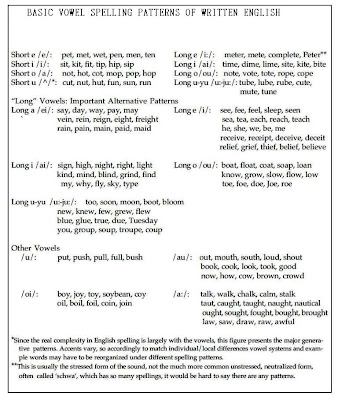
Activity One: Pronunciation and Phonics Crambo (an adaptation of a
1. Preparation: Go through student word lists (e.g., the lexical part of the syllabus of a course book) and select words that fit major and minor spelling patterns. Also, choose key sight words (which are also a major part of a beginner's vocabulary). Think of other rhyming words that students may not know, but that fit the patterns that the course vocabulary illustrate.
2. Pre-teaching: Explain/show what an English rhyme is, as Japanese students may have difficulty with the concept. Young learners especially may be quite open to language play, but their linguistic sense of it will be geared to the characteristics of Japanese, not English. Rhyme is one of these characteristics on which English and Japanese (but also Romance languages like Spanish and Italian) differ greatly. Show them how words can rhyme and have the same spelling pattern: e.g., time, lime, dime, etc. Also show them how words can rhyme but have totally different spellings: e.g., time, rhyme, climb. You can also show them how common sight words complicate matters still further: two, you, who.
3. Divide the class into teams. I have used this activity a lot for classes that could be divided into two teams, but more teams than that are possible. Two players from each team can come to the board. One will write for their team, while the other can relay information from the rest of the team members. This activity can be run having students rely solely on memory, or they can be encouraged to use textbooks, glossaries and dictionaries for the words they will need. Begin play by announcing a key word and writing it top, center on the board. Repeat the word several times. The first team to write a correct rhyme wins a point. Continue play with different team members rotating for each round. Emphasize that this is a team effort, so the members who are at their seats should give assistance to the two at the board.
4. Variations: Practice words that have the same vowel sound but do not rhyme. Or words that begin or end with the same target sound, such as problem sounds like /r/ or /l/ (in this case you will want only to say the key word several times and not write anything on the board).
Activity Two: Spelling Concentration (an EFL adaptation of Concentration)
1. Construct a set of word cards from large pieces of cardboard (I have used A4 and B4 sizes). On one side of each card print a key word. The words on the cards should be organized so that there are matching pairs of rhyming words or words that share the same internal vowel sounds (e.g., same sound-same spelling, same sound-different spelling, selected sight words). For example, in one set of cards I matched in non-rhymes, five pairs of short vowels (bad-cat, bed-pet, sit-tip, not-top, cut-cup), five pairs of 'long' vowels (ate-day, feet-heat, kite-sight, note-boat, room-tune), and three pairs with other vowels (out-town, loop-soon, boy-oil) for a total of 26 cards (see Figure 1 for a list of vowel spelling patterns). After you have written all the key words on the cards, shuffle the deck thoroughly, then number the cards at random on their reverse sides, from 1 to 26. Tape or magnetically fix the word cards to the blackboard with the numbered sides showing.
2. This game works best if played between two teams, but team sizes should be kept down to groups that are small enough for all to participate. If you team teach, you might want to split up a large class and run two different games. There is not a lot of pre-teaching required for this game if the previous activity has already been done (teaching what words rhyme, how they might share an internal vowel, how they might begin or end with the same sound, etc.). You might want to run a demonstration round to show how the Concentration game will go.
3. One of the two teams must begin play; this can be decided at random since going first does not increase the odds of winning. The side that starts picks any two cards by calling out their numbers (this also gives beginners a chance to say the numerals in English out loud in real communication). The teacher (or appointed M.C.) turns the cards over so that they display their key words. The teacher says the words out loud several times so that the whole class can hear. If the two words on the cards match according to the teaching point of the game (e.g., rhymes, internal vowel sounds, initial sounds, final sounds, etc.), the two cards are taken down and given to the side that chose them. If cards are won, play continues with the same side getting the chance to call out two more numbers. The turn changes if two cards are turned over but the words do not match. Keep playing until all the cards have been matched and given to a side.
4. Hint on making this game work: point out to the teams that they need to split up memorization duties among their members; however, do not let them keep any written notes.
Activity Three: Phonics Snap (an EFL adaptation of the card game, Snap!)
1. Prepare a list of words from student vocabulary. Select these words on the basis of the spelling patterns they illustrate (for example, the most basic patterns of the five short vowels and the five long vowels). Think of words that both rhyme and illustrate the same spelling patterns and add them to the list (they may be from previously studied vocabulary, or they can be new words that should be de-codable if phonics skills are used). Using the words you have collected, construct a set of 72 cards, one word on each card. The object of this game depends on randomly matching rhyming words, so be sure to include a large number of only a few rhymes (for example, a deck that is limited to the major patterns for the five long vowels). In short, this game does not work if there aren't enough examples of each rhyme. Because of the complexity of English spelling, it is possible to construct games to emphasize many different points. Some possibilities might include: rhymes with the same spelling, rhymes with different spellings, or rhymes with various spellings along with an occasional sight word, which should always come from known vocabulary (for example, eye might be matched with pie, my and buy).
2. This game is best played in pairs. Decks for an entire class could be used while the teacher checks how students are doing. Also, the teacher could play this game with a student who needs extra practice with English spelling and pronunciation. Team teaching would allow for this game to be used with a larger class. The two teachers could demonstrate it better, and they could cover more of the classroom when helping students learn to play it.
3. Have students form pairs. Distribute one deck of cards to each pair. After shuffling and dealing the cards (face down), one player begins play by placing their top card face up on the desk and pronouncing the word (e.g. light). The other player then lays a card on top of the previous one and pronounces it (e.g. late). Play continues in turn until a rhyming card has been laid on top of the previous one (e.g., seen then bean). At that instant, the first player to recognize the rhyme and say 'Snap!' wins all the cards that have been laid. Players should not cheat by looking at their cards before they lay them, a point that should be stressed when the game is demonstrated and monitored. Players keep doing this until one player has won all the cards.
---------
Usage notes: Creative Commons 3.0 applies. This means you are pretty much free to use and/or distribute, but with a couple provisions: (1) you credit and link back to this page, (2) you do not alter without the permission of the author ( Charles Jannuzi, jannuzi@gmail.com ).
Charles Jannuzi, University of Fukui, Japan
You can refer to this graphic, 'Basic Vowel Spelling Patterns of Written English' for words and spelling patterns to use in the activities explained below.

Activity One: Pronunciation and Phonics Crambo (an adaptation of a
traditional spelling game)
1. Preparation: Go through student word lists (e.g., the lexical part of the syllabus of a course book) and select words that fit major and minor spelling patterns. Also, choose key sight words (which are also a major part of a beginner's vocabulary). Think of other rhyming words that students may not know, but that fit the patterns that the course vocabulary illustrate.
2. Pre-teaching: Explain/show what an English rhyme is, as Japanese students may have difficulty with the concept. Young learners especially may be quite open to language play, but their linguistic sense of it will be geared to the characteristics of Japanese, not English. Rhyme is one of these characteristics on which English and Japanese (but also Romance languages like Spanish and Italian) differ greatly. Show them how words can rhyme and have the same spelling pattern: e.g., time, lime, dime, etc. Also show them how words can rhyme but have totally different spellings: e.g., time, rhyme, climb. You can also show them how common sight words complicate matters still further: two, you, who.
3. Divide the class into teams. I have used this activity a lot for classes that could be divided into two teams, but more teams than that are possible. Two players from each team can come to the board. One will write for their team, while the other can relay information from the rest of the team members. This activity can be run having students rely solely on memory, or they can be encouraged to use textbooks, glossaries and dictionaries for the words they will need. Begin play by announcing a key word and writing it top, center on the board. Repeat the word several times. The first team to write a correct rhyme wins a point. Continue play with different team members rotating for each round. Emphasize that this is a team effort, so the members who are at their seats should give assistance to the two at the board.
4. Variations: Practice words that have the same vowel sound but do not rhyme. Or words that begin or end with the same target sound, such as problem sounds like /r/ or /l/ (in this case you will want only to say the key word several times and not write anything on the board).
Activity Two: Spelling Concentration (an EFL adaptation of Concentration)
1. Construct a set of word cards from large pieces of cardboard (I have used A4 and B4 sizes). On one side of each card print a key word. The words on the cards should be organized so that there are matching pairs of rhyming words or words that share the same internal vowel sounds (e.g., same sound-same spelling, same sound-different spelling, selected sight words). For example, in one set of cards I matched in non-rhymes, five pairs of short vowels (bad-cat, bed-pet, sit-tip, not-top, cut-cup), five pairs of 'long' vowels (ate-day, feet-heat, kite-sight, note-boat, room-tune), and three pairs with other vowels (out-town, loop-soon, boy-oil) for a total of 26 cards (see Figure 1 for a list of vowel spelling patterns). After you have written all the key words on the cards, shuffle the deck thoroughly, then number the cards at random on their reverse sides, from 1 to 26. Tape or magnetically fix the word cards to the blackboard with the numbered sides showing.
2. This game works best if played between two teams, but team sizes should be kept down to groups that are small enough for all to participate. If you team teach, you might want to split up a large class and run two different games. There is not a lot of pre-teaching required for this game if the previous activity has already been done (teaching what words rhyme, how they might share an internal vowel, how they might begin or end with the same sound, etc.). You might want to run a demonstration round to show how the Concentration game will go.
3. One of the two teams must begin play; this can be decided at random since going first does not increase the odds of winning. The side that starts picks any two cards by calling out their numbers (this also gives beginners a chance to say the numerals in English out loud in real communication). The teacher (or appointed M.C.) turns the cards over so that they display their key words. The teacher says the words out loud several times so that the whole class can hear. If the two words on the cards match according to the teaching point of the game (e.g., rhymes, internal vowel sounds, initial sounds, final sounds, etc.), the two cards are taken down and given to the side that chose them. If cards are won, play continues with the same side getting the chance to call out two more numbers. The turn changes if two cards are turned over but the words do not match. Keep playing until all the cards have been matched and given to a side.
4. Hint on making this game work: point out to the teams that they need to split up memorization duties among their members; however, do not let them keep any written notes.
Activity Three: Phonics Snap (an EFL adaptation of the card game, Snap!)
1. Prepare a list of words from student vocabulary. Select these words on the basis of the spelling patterns they illustrate (for example, the most basic patterns of the five short vowels and the five long vowels). Think of words that both rhyme and illustrate the same spelling patterns and add them to the list (they may be from previously studied vocabulary, or they can be new words that should be de-codable if phonics skills are used). Using the words you have collected, construct a set of 72 cards, one word on each card. The object of this game depends on randomly matching rhyming words, so be sure to include a large number of only a few rhymes (for example, a deck that is limited to the major patterns for the five long vowels). In short, this game does not work if there aren't enough examples of each rhyme. Because of the complexity of English spelling, it is possible to construct games to emphasize many different points. Some possibilities might include: rhymes with the same spelling, rhymes with different spellings, or rhymes with various spellings along with an occasional sight word, which should always come from known vocabulary (for example, eye might be matched with pie, my and buy).
2. This game is best played in pairs. Decks for an entire class could be used while the teacher checks how students are doing. Also, the teacher could play this game with a student who needs extra practice with English spelling and pronunciation. Team teaching would allow for this game to be used with a larger class. The two teachers could demonstrate it better, and they could cover more of the classroom when helping students learn to play it.
3. Have students form pairs. Distribute one deck of cards to each pair. After shuffling and dealing the cards (face down), one player begins play by placing their top card face up on the desk and pronouncing the word (e.g. light). The other player then lays a card on top of the previous one and pronounces it (e.g. late). Play continues in turn until a rhyming card has been laid on top of the previous one (e.g., seen then bean). At that instant, the first player to recognize the rhyme and say 'Snap!' wins all the cards that have been laid. Players should not cheat by looking at their cards before they lay them, a point that should be stressed when the game is demonstrated and monitored. Players keep doing this until one player has won all the cards.
---------
Usage notes: Creative Commons 3.0 applies. This means you are pretty much free to use and/or distribute, but with a couple provisions: (1) you credit and link back to this page, (2) you do not alter without the permission of the author ( Charles Jannuzi, jannuzi@gmail.com ).
27 August 2010
ELT in Japan, Issue #3 (August-September 2010)
Article 1: Schema theory: Is this set of concepts relevant to TEFL?
Article 2: Truespel - the English-based phonetic notation for both ESL and EFL
Article 3: Writing systems across languages and cultures: Implications for language teaching and learning
Article 4: Japanese publishers of EFL books for self-study/ 自習のための言語・英語材料の出版社
Article 5: Key concepts in EFL literacy: Phonics vs. whole language
Article 6: Three phonics, spelling and whole word activities for EFL learners
Article 7: Should the JET Programme be axed?
ELT in Japan Issue #3 (August 2010) Feature 4: Japanese publishers of EFL books for self-study/ 自習のための言語・英語材料の出版社
ELT in Japan, Issue #3 (August 2010)
Feature 4: Japanese publishers of EFL books for self-study/ 自習のための言語・英語材料の出版社 Charles Jannuzi, University of Fukui, Japan
Self-study is really a potential growth market for many publishers, including the ones who dominate university textbooks. So there is potential for overlap with the list of publishers of Japanese EFL university textbooks. More companies will move into self-study materials to try and offset the declining cohorts of young people. Even if university and tertiary enrollment hasn't started to decline yet, it is somewhat stagnant. Perhaps the decline in enrollment has been delayed by the final expansion of the tertiary sector opening up more enrollment slots combined with the fact that more young people stay out of the full-time workforce and in education or training longer.
I have listed here mostly publishers who didn't make it into the previous list of textbook publishers. English-language pages are rare at these websites, although there are some.
Sunmark even has an online and downloadable catalogue of English-language titles, usually in the areas of 'inspirational' and 'self-help/self-improvement'. Kodansha is a renowned publisher of English-language titles for Japanese language and cultural studies, but is also a major publisher in the Japanese language. The NHK listed here is the publishing arm of the national broadcaster; NHK produces EFL programs for both radio and TV and these have text magazine and textbooks or supplementary materials associated with the program (such as the Dr. Corpus materials).
ALC, DHC (the publishing arm of the cosmetics and nutritional supplements company) and Z-Kai have carved out niches in correspondence courses, and these have stand-alone self-study books (e.g., on English listening, English reading, TOEIC, etc.) that can be bought and used separately (such as adapted to your own EFL courses).
I have tried to list useful links to get you into the parts of the online listings of EFL-related titles in order to save you time in navigating Japanese-language sites.
The benefits of adapting some of these materials to your university, college and other tertiary-level EFL courses include the following:
(1) These materials will be understood by all students because explanations are in Japanese;
(2) such materials often contain a lot of tips, hints, coaching advice and motivational material in the language that all students will understand;
(3) these titles tend to be more practical than the university publishers', although there is a lot of overlap and the trend is toward convergence under the category of 'edutainment' and 'infotainment'; and
(4) these materials are self-contained and self-sufficient (with CDs, DVDs, answer keys), so the learners who are more keen can continue to use them after the course is over.
I have used such self-study materials for TOEIC study classes, and I use bi-lingual screenplays in some General English classes in order to add extensive reading and listening components, areas that have long been neglected in TEFL in Japan.
ALC アルク
http://www.alc.co.jp/
http://www.alc.co.jp/eng/index.html
http://shop.alc.co.jp/cnt/bunya/?afcd=leftjs_bunya_top
Chukei 中経
http://www.chukei.co.jp/
http://www.chukei.co.jp/language/
http://www.chukei.co.jp/language/news.php
http://www.chukei.co.jp/search/index.php?search=1&obj_type=obj_3&category=2&sub_category=211
Cosmic - includes Bi-lingual Screenplays w/DVDs
http://www.cosmicpub.jp/shopdetail/006008000009/
英語とEnglishをつなぐDHCの英語講座 English Language Education of DHC http://www.edu.dhc.co.jp/
http://www.edu.dhc.co.jp/fun_study/ info@edu.dhc.co.jp
DHC English language study materials
http://www.dhc.co.jp/goods/cagoods.jsp?cCode=11218000
DHC English language study materials - bilingual screenplay books
http://www.dhc.co.jp/goods/cagoods.jsp?cCode=11218009
Diamond ダイヤモンド社
http://www.diamond.co.jp http://book.diamond.co.jp/
J-Research 有限会社 ジェイ・リサーチ出版 Jリサーチ出版
http://www.jresearch.co.jp/
http://www.jresearch.co.jp/category/books/107/
http://www.jresearch.co.jp/category/books/106/
Kodansha
http://www.kodansha-intl.com/
http://www.kodansha-intl.com/contents/categoryBookList.php?cid=114&c2id=11401
http://www.kodansha.co.jp/
http://www.kodansha.co.jp/english/
Natsume Publishing ナツメ出版
http://www.natsume.co.jp/
http://www.natsume.co.jp/book/index.php?keyword=%B1%D1%B8%EC&S_FIND_x=%B8%A1%BA%F7&x=31&y=3
http://www.natsume.co.jp/book/index.php?action=show&code=004464 http://www.natsume.co.jp/book/index.php?action=show&code=004491
NHK
https://www.nhk-book.co.jp/shop/main.jsp?trxID=0010
https://www.nhk-book.co.jp/shop/main.jsp?trxID=C1010101&htmlPageCode=08.html
https://www.nhk-book.co.jp/shop/main.jsp?trxID=C2010101&bookCategoryCode=23002
https://www.nhk-book.co.jp/shop/main.jsp?query=&whence=0&sort=score&reference=off&max=10&result=normal&searchCategoryName=01&targetWords=%89p%8C%EA&trxID=C0020101
Obunsha 旺文社
http://www.obunsha.co.jp/
http://www.obunsha.co.jp/shoshi/index.php/search/doSearch?cx=006468615939608868044%3Ayalzetngdoq&cof=FORID%3A9&q=%E8%8B%B1%E8%AA%9E#1521
info@obunsha.co.jp
pr@obunsha.co.jp
Sunmark サンマーク出版
http://www.sunmark.co.jp/
http://www.sunmark.co.jp/eng/index.html
http://www.sunmark.co.jp/eng/general_catalog.pdf
http://www.sunmark.co.jp/01/rc/genre15.html
Screenplay - Bilingual screenplays, listening, conversation materials スクリーンプレ http://www.screenplay.co.jp/
Takarajimasha - Includes Bilingual screenplays w/DVDs 宝島社
http://tkj.jp/
http://tkj.jp/search/?cs=u&fw=%E5%90%8D%E4%BD%9C%E6%98%A0%E7%94%BB http://tkj.jp/search/?cs=u&fw=%E5%90%8D%E4%BD%9C%E6%98%A0%E7%94%BB%E3%81%A7%E8%8B%B1%E4%BC%9A%E8%A9%B1%E3%82%B7%E3%83%AA%E3%83%BC%E3%82%BA
Z-Kai Z-会
http://www.zkai.co.jp/home/index.html
http://www.zkai.co.jp/top/daitop.html
http://www.zkai.co.jp/books/index.html
http://www.zkai.co.jp/books/search/list_3.asp
http://www.zkai.co.jp/books/search/list_5.asp#BookInf1
https://www.zkai.co.jp/ca/g/catalog/index.asp
-------------------------------
Creative Commons Licence 3.0 and its provisions apply.
Feature 4: Japanese publishers of EFL books for self-study/ 自習のための言語・英語材料の出版社 Charles Jannuzi, University of Fukui, Japan
Self-study is really a potential growth market for many publishers, including the ones who dominate university textbooks. So there is potential for overlap with the list of publishers of Japanese EFL university textbooks. More companies will move into self-study materials to try and offset the declining cohorts of young people. Even if university and tertiary enrollment hasn't started to decline yet, it is somewhat stagnant. Perhaps the decline in enrollment has been delayed by the final expansion of the tertiary sector opening up more enrollment slots combined with the fact that more young people stay out of the full-time workforce and in education or training longer.
I have listed here mostly publishers who didn't make it into the previous list of textbook publishers. English-language pages are rare at these websites, although there are some.
Sunmark even has an online and downloadable catalogue of English-language titles, usually in the areas of 'inspirational' and 'self-help/self-improvement'. Kodansha is a renowned publisher of English-language titles for Japanese language and cultural studies, but is also a major publisher in the Japanese language. The NHK listed here is the publishing arm of the national broadcaster; NHK produces EFL programs for both radio and TV and these have text magazine and textbooks or supplementary materials associated with the program (such as the Dr. Corpus materials).
ALC, DHC (the publishing arm of the cosmetics and nutritional supplements company) and Z-Kai have carved out niches in correspondence courses, and these have stand-alone self-study books (e.g., on English listening, English reading, TOEIC, etc.) that can be bought and used separately (such as adapted to your own EFL courses).
I have tried to list useful links to get you into the parts of the online listings of EFL-related titles in order to save you time in navigating Japanese-language sites.
The benefits of adapting some of these materials to your university, college and other tertiary-level EFL courses include the following:
(1) These materials will be understood by all students because explanations are in Japanese;
(2) such materials often contain a lot of tips, hints, coaching advice and motivational material in the language that all students will understand;
(3) these titles tend to be more practical than the university publishers', although there is a lot of overlap and the trend is toward convergence under the category of 'edutainment' and 'infotainment'; and
(4) these materials are self-contained and self-sufficient (with CDs, DVDs, answer keys), so the learners who are more keen can continue to use them after the course is over.
I have used such self-study materials for TOEIC study classes, and I use bi-lingual screenplays in some General English classes in order to add extensive reading and listening components, areas that have long been neglected in TEFL in Japan.
ALC アルク
http://www.alc.co.jp/
http://www.alc.co.jp/eng/index.html
http://shop.alc.co.jp/cnt/bunya/?afcd=leftjs_bunya_top
Chukei 中経
http://www.chukei.co.jp/
http://www.chukei.co.jp/language/
http://www.chukei.co.jp/language/news.php
http://www.chukei.co.jp/search/index.php?search=1&obj_type=obj_3&category=2&sub_category=211
Cosmic - includes Bi-lingual Screenplays w/DVDs
http://www.cosmicpub.jp/shopdetail/006008000009/
英語とEnglishをつなぐDHCの英語講座 English Language Education of DHC http://www.edu.dhc.co.jp/
http://www.edu.dhc.co.jp/fun_study/ info@edu.dhc.co.jp
DHC English language study materials
http://www.dhc.co.jp/goods/cagoods.jsp?cCode=11218000
DHC English language study materials - bilingual screenplay books
http://www.dhc.co.jp/goods/cagoods.jsp?cCode=11218009
Diamond ダイヤモンド社
http://www.diamond.co.jp http://book.diamond.co.jp/
J-Research 有限会社 ジェイ・リサーチ出版 Jリサーチ出版
http://www.jresearch.co.jp/
http://www.jresearch.co.jp/category/books/107/
http://www.jresearch.co.jp/category/books/106/
Kodansha
http://www.kodansha-intl.com/
http://www.kodansha-intl.com/contents/categoryBookList.php?cid=114&c2id=11401
http://www.kodansha.co.jp/
http://www.kodansha.co.jp/english/
Natsume Publishing ナツメ出版
http://www.natsume.co.jp/
http://www.natsume.co.jp/book/index.php?keyword=%B1%D1%B8%EC&S_FIND_x=%B8%A1%BA%F7&x=31&y=3
http://www.natsume.co.jp/book/index.php?action=show&code=004464 http://www.natsume.co.jp/book/index.php?action=show&code=004491
NHK
https://www.nhk-book.co.jp/shop/main.jsp?trxID=0010
https://www.nhk-book.co.jp/shop/main.jsp?trxID=C1010101&htmlPageCode=08.html
https://www.nhk-book.co.jp/shop/main.jsp?trxID=C2010101&bookCategoryCode=23002
https://www.nhk-book.co.jp/shop/main.jsp?query=&whence=0&sort=score&reference=off&max=10&result=normal&searchCategoryName=01&targetWords=%89p%8C%EA&trxID=C0020101
Obunsha 旺文社
http://www.obunsha.co.jp/
http://www.obunsha.co.jp/shoshi/index.php/search/doSearch?cx=006468615939608868044%3Ayalzetngdoq&cof=FORID%3A9&q=%E8%8B%B1%E8%AA%9E#1521
info@obunsha.co.jp
pr@obunsha.co.jp
Sunmark サンマーク出版
http://www.sunmark.co.jp/
http://www.sunmark.co.jp/eng/index.html
http://www.sunmark.co.jp/eng/general_catalog.pdf
http://www.sunmark.co.jp/01/rc/genre15.html
Screenplay - Bilingual screenplays, listening, conversation materials スクリーンプレ http://www.screenplay.co.jp/
Takarajimasha - Includes Bilingual screenplays w/DVDs 宝島社
http://tkj.jp/
http://tkj.jp/search/?cs=u&fw=%E5%90%8D%E4%BD%9C%E6%98%A0%E7%94%BB http://tkj.jp/search/?cs=u&fw=%E5%90%8D%E4%BD%9C%E6%98%A0%E7%94%BB%E3%81%A7%E8%8B%B1%E4%BC%9A%E8%A9%B1%E3%82%B7%E3%83%AA%E3%83%BC%E3%82%BA
Z-Kai Z-会
http://www.zkai.co.jp/home/index.html
http://www.zkai.co.jp/top/daitop.html
http://www.zkai.co.jp/books/index.html
http://www.zkai.co.jp/books/search/list_3.asp
http://www.zkai.co.jp/books/search/list_5.asp#BookInf1
https://www.zkai.co.jp/ca/g/catalog/index.asp
-------------------------------
Creative Commons Licence 3.0 and its provisions apply.
ELT in Japan Issue #3 (August 2010) Feature 3: Writing Systems Across Languages and Cultures: Implications for Language Teaching and Learning
Note: this is a different version of the articles on the implications of writing systems for EFL literacy. This article includes specific discussion of classroom activities and content for materials writing. It also has enhanced graphics which are better than previous versions.
ELT in Japan, Issue #3 (August 2010)
Feature 3: Writing systems across languages and cultures: Implications for language teaching and learning
Charles Jannuzi, University of Fukui, Japan
Introduction
TESOL practitioners anticipate some degree of interference from the native language of their students. The explanatory power of L1 interference and contrastive analysis has been de-emphasized in recent theory and research. Nor can we think that all linguistic, meta-linguistic and literacy transfer effects have a negative impact on L2 acquisition. However, if the students' first language is not closely related to English nor English widely used in the native culture (i.e., EFL situations or in some ESL countries where English is a minority or socially limited language), we might reasonably expect a longer initial 'latent' stage.
To read the rest of the paper as a googledoc, click on the link below. For best results in displaying the document (.pdf), download it from googledocs and open with Adobe Acrobat Reader.
Read the entire article, "Writing systems across languages and cultures: Implications for language teaching and learning" here.
Download .pdf here:
https://docs.google.com/uc?export=download&id=1Bo3BSEjeYX6gmJsuLXtocCTuPs_HBPSDYBDCwDNeZad-xaqWYJLuTtXqLZNR
-------------------------------
Creative Commons Licence 3.0 and its provisions apply.
ELT in Japan, Issue #3 (August 2010)
Feature 3: Writing systems across languages and cultures: Implications for language teaching and learning
Charles Jannuzi, University of Fukui, Japan
Introduction
TESOL practitioners anticipate some degree of interference from the native language of their students. The explanatory power of L1 interference and contrastive analysis has been de-emphasized in recent theory and research. Nor can we think that all linguistic, meta-linguistic and literacy transfer effects have a negative impact on L2 acquisition. However, if the students' first language is not closely related to English nor English widely used in the native culture (i.e., EFL situations or in some ESL countries where English is a minority or socially limited language), we might reasonably expect a longer initial 'latent' stage.
To read the rest of the paper as a googledoc, click on the link below. For best results in displaying the document (.pdf), download it from googledocs and open with Adobe Acrobat Reader.
Read the entire article, "Writing systems across languages and cultures: Implications for language teaching and learning" here.
Download .pdf here:
https://docs.google.com/uc?export=download&id=1Bo3BSEjeYX6gmJsuLXtocCTuPs_HBPSDYBDCwDNeZad-xaqWYJLuTtXqLZNR
-------------------------------
Creative Commons Licence 3.0 and its provisions apply.
ELT in Japan Issue #3 (August 2010) Feature 2: Truespel - the English-Based Phonetic Notation for ESL and EFL as Well
ELT in Japan, Issue #3 (August 2010)
Feature 2: Truespel - the English-based phonetic notation for both ESL and EFL
Tom Zurinskas, www.truespel.com
Truespel phonetic notation was created in 1986 to answer the question: What would phonetics look like based on English? After all, if English is the lingua franca of the world, shouldn't phonetics (for ESL and EFL learning) be based on it as well? The result is truespel, a phonetic notation very close in appearance to traditional English. Truespel is so close to traditional spelling that a tilde <~> is used to identify it. Its the first phonetic system with a unique identifier.
In 1986 I was a human factors specialist looking into standardizing man-machine interfaces. I found that pronunciation guides were not standardized nor human or computer-friendly, not even useful for basic copy/paste functions. Even academic notations such as the International Phonetic Association (IPA) were unfriendly, using a mix of languages and codes (symbols) to spell sounds. Thus, phonetics, because of its coding complexity, is not taught to children in the US for reading instruction. This impacts phonemic and phonological awareness, which are key correlates to successful beginning reading development. But truespel makes this possible for the first time.
Truespel is a consistent scheme of one spelling per sound for US English. This scheme was researched through the Simplified Spelling Society, now The Spelling Society, whose main goal is to respell English consistently. That objective would result in written English being more like Finnish, which can be learned (for literacy purposes) in months rather than years. However, reform of English is extremely hard to do.
The truespel goal instead is to supply a pronunciation guide to assist readers with pronunciation and phonetic look-ups in an English-like way. The objective is to spell the sounds of English using the most frequent English sound spellings, or at least those that are least conflicting with traditional spelling. For certain sounds, this is not easy to do, especially for vowels. There are 17 (or so) vowel sounds in English and only five vowel letters to spell them. For example, the letter in the following words, on, do, off, of, fort, word, go, and pilot, each spell a different sound.
Let's look at another example of the complexity and confusion that is possible with another vowel letter. There are 6 vowel letters in English,. But there are 17 vowel sounds (with some vowel inventories expanding beyond this count). Thus, vowel letters must represent more than one sound in English.
Let’s look at the letter and the sounds it represents. We'll use truespel (indicated by a tilde ~) for phonetic spelling. The data are from truespel book 4, which contains counts of words in print (thus sounds as well, typical of spoken USA English). USA English is the dialect.
The letter stands for many sounds, but has one sound it represents consistently. This sound is “short a” (~a), as in 'cat' (~kat). The top word having this sound is 'and' (~and). In fact, representing the “short a” sound (~a) by the letter is so consistent that it happens over 99% of the time, making it the most consistent vowel representation for USA English.
But the letter represents other sounds as well. In fact, there is a word 'a', which is represented by the letter, but takes the sound 'uh' (~u) as in 'sofa' (~soefu).
What sounds are spelled by letter? Below is a list. The percentages mean that if you see the letter alone, these are the chances that it represents these sounds. The sample words are the top words in USA English with that sound.
~a top word 'and' (~and) 54%
~u top word 'was' (~wuz) 30%
~aa top word 'are' (~aar) 8%
~oo top word 'social' (soeshool) 5% ( taken as )
~i top word 'important' (~impportint) 3%
Also the letter can be combined with other vowels to indicate various sounds. Below are frequencies of sounds in USA English for letter strings (digraphs) of and .
Sounds for letter string
~ae top word 'main' (~maen) 40%
~e top word 'said' (~sed) 39%
~air top word 'air' (~air) 11%
~i top word 'captain' (~kaptin) 10%
Sounds for letter string
~ee top word 'years' (~yeerz) 66%
~e top word 'head' (~hed) 28%
~ae top word 'great' (~graet) 6%
There are more words in running text beginning with letter 39% (do in large part to the frequency of 'and') than ending with letter 9%, with the rest 52% of the 's in the middle of words.
So to establish a way to spell each sound only one way will change the look of many words, just as all the vowels in these words must change but one to reflect their component sounds.
How were the much more limited and consistent sound-spellings of truepsel chosen? Using a scientific approach to find the best spellings, I analyzed English in truespel books 1 and 4 (all books are at Authorhouse.com). Book 1 analyzed a large dictionary list where letter-sound correspondences are examined for a large list of words spelled once. Book 4 analyzes a frequency list of the top 5k words found in typical text (which counts repeated words and thus counts repeated sounds). The two analyses verified the reasonableness of the sound spellings of truespel and find a lot of facts about the frequency of how US English sounds are spelled.
What made these studies possible were; (1) the spreadsheet-friendliness of truespel; and (2) 'talking' dictionaries as models of pronunciation. The models used were for US English, which is the most prevalent accent (70% of native English speakers live in the US). The result is a phonetic spelling that is more accurate than others for US English, because (1) it's recent and (2) all the vague schwa symbols are clarified (Note that the schwa symbol in pronunciation guides represents many different indistinct vowel sounds and is thus confusing).
To see a truespel dictionary pronunciation guide, there is truespel book 3, which is the Voice of American Intermediate English Dictionary. This pronunciation guide includes typical USA alternative pronunciations that all other dictionaries should include but do not. Also, Truespel book 4 shows a large list of English words and their truespel equivalent, but with the truespel word first so its a phonetic look-up manual.
How consistent is the letter-sound correspondence of English? In statistical terms, it's mostly consistent, especially for consonants. My research shows that for English, 90% of consonants are spelled in the most frequent way, while only 50% of the vowels are. But the inconsistencies mean that many words need to be sight memorized. Thats why a phonetic guide would be most helpful to show the pronunciation. Truespel provides such a guide, and it's free. Truespel.com has a free phonetic converter provided by Joe Davidson of Interguru. Text can be pasted into it and converted to phonetics and vice versa. Teachers can create pronunciation lessons using it. The site also has a web page converter, so the entire internet sites can be converted to truespel using it. Because of the power of computers and internet, truespel is everywhere.
Is truespel a hard thing to learn? No, truespel is much simpler than other phonetic notations. US University grad students using it said they took only 15 minutes to learn it. This is because 30 out of 40 phoneme spellings are self-evident, patterned on present spelling. Literate English-speaking 3rd graders should be able to learn truespel in about an hour. The beauty is that truespel is an actual spelling system because its capitalization-friendly, punctuation-friendly, copy/paste-friendly, filename-friendly, and spreadsheet-friendly. No other notation can claim this.
Usefulness is the key. Teachers can use truespel to:
1. Show beginning readers the sounds of English to teach phonemic and phonological awareness
2. Show English pronunciation to ESL students.
3. Show pronunciation of words from other languages in truespel translation guides (once created).
4. Integrate all English literacy aspects for the first time - reading instruction, pronunciation materials, dictionary pronunciation guides, translation guides, phonemic aptitude tools, and analysis tools.
The future goal is complete integration, which does not exist now. For a quick tutorial on truespel regarding the 40 sounds of USA English in a simple story see http://tinyurl.com/yh46rgc and see http://tinyurl.com/yls55da for indicating stress in truespel. Basically, thats all you need except for practice, practice, practice.
For further information about truespel, contact Tom Zurinskas, creator of truespel at tzurinskas@yahoo.com .
Feature 2: Truespel - the English-based phonetic notation for both ESL and EFL
Tom Zurinskas, www.truespel.com
Truespel phonetic notation was created in 1986 to answer the question: What would phonetics look like based on English? After all, if English is the lingua franca of the world, shouldn't phonetics (for ESL and EFL learning) be based on it as well? The result is truespel, a phonetic notation very close in appearance to traditional English. Truespel is so close to traditional spelling that a tilde <~> is used to identify it. Its the first phonetic system with a unique identifier.
In 1986 I was a human factors specialist looking into standardizing man-machine interfaces. I found that pronunciation guides were not standardized nor human or computer-friendly, not even useful for basic copy/paste functions. Even academic notations such as the International Phonetic Association (IPA) were unfriendly, using a mix of languages and codes (symbols) to spell sounds. Thus, phonetics, because of its coding complexity, is not taught to children in the US for reading instruction. This impacts phonemic and phonological awareness, which are key correlates to successful beginning reading development. But truespel makes this possible for the first time.
Truespel is a consistent scheme of one spelling per sound for US English. This scheme was researched through the Simplified Spelling Society, now The Spelling Society, whose main goal is to respell English consistently. That objective would result in written English being more like Finnish, which can be learned (for literacy purposes) in months rather than years. However, reform of English is extremely hard to do.
The truespel goal instead is to supply a pronunciation guide to assist readers with pronunciation and phonetic look-ups in an English-like way. The objective is to spell the sounds of English using the most frequent English sound spellings, or at least those that are least conflicting with traditional spelling. For certain sounds, this is not easy to do, especially for vowels. There are 17 (or so) vowel sounds in English and only five vowel letters to spell them. For example, the letter
Let's look at another example of the complexity and confusion that is possible with another vowel letter. There are 6 vowel letters in English,
Let’s look at the letter and the sounds it represents. We'll use truespel (indicated by a tilde ~) for phonetic spelling. The data are from truespel book 4, which contains counts of words in print (thus sounds as well, typical of spoken USA English). USA English is the dialect.
The letter stands for many sounds, but has one sound it represents consistently. This sound is “short a” (~a), as in 'cat' (~kat). The top word having this sound is 'and' (~and). In fact, representing the “short a” sound (~a) by the letter is so consistent that it happens over 99% of the time, making it the most consistent vowel representation for USA English.
But the letter represents other sounds as well. In fact, there is a word 'a', which is represented by the letter, but takes the sound 'uh' (~u) as in 'sofa' (~soefu).
What sounds are spelled by letter? Below is a list. The percentages mean that if you see the letter alone, these are the chances that it represents these sounds. The sample words are the top words in USA English with that sound.
~a top word 'and' (~and) 54%
~u top word 'was' (~wuz) 30%
~aa top word 'are' (~aar) 8%
~oo top word 'social' (soeshool) 5% (
~i top word 'important' (~impportint) 3%
Also the letter can be combined with other vowels to indicate various sounds. Below are frequencies of sounds in USA English for letter strings (digraphs) of and .
Sounds for letter string
~ae top word 'main' (~maen) 40%
~e top word 'said' (~sed) 39%
~air top word 'air' (~air) 11%
~i top word 'captain' (~kaptin) 10%
Sounds for letter string
~ee top word 'years' (~yeerz) 66%
~e top word 'head' (~hed) 28%
~ae top word 'great' (~graet) 6%
There are more words in running text beginning with letter 39% (do in large part to the frequency of 'and') than ending with letter 9%, with the rest 52% of the 's in the middle of words.
So to establish a way to spell each sound only one way will change the look of many words, just as all the vowels in these words must change but one to reflect their component sounds.
How were the much more limited and consistent sound-spellings of truepsel chosen? Using a scientific approach to find the best spellings, I analyzed English in truespel books 1 and 4 (all books are at Authorhouse.com). Book 1 analyzed a large dictionary list where letter-sound correspondences are examined for a large list of words spelled once. Book 4 analyzes a frequency list of the top 5k words found in typical text (which counts repeated words and thus counts repeated sounds). The two analyses verified the reasonableness of the sound spellings of truespel and find a lot of facts about the frequency of how US English sounds are spelled.
What made these studies possible were; (1) the spreadsheet-friendliness of truespel; and (2) 'talking' dictionaries as models of pronunciation. The models used were for US English, which is the most prevalent accent (70% of native English speakers live in the US). The result is a phonetic spelling that is more accurate than others for US English, because (1) it's recent and (2) all the vague schwa symbols are clarified (Note that the schwa symbol in pronunciation guides represents many different indistinct vowel sounds and is thus confusing).
To see a truespel dictionary pronunciation guide, there is truespel book 3, which is the Voice of American Intermediate English Dictionary. This pronunciation guide includes typical USA alternative pronunciations that all other dictionaries should include but do not. Also, Truespel book 4 shows a large list of English words and their truespel equivalent, but with the truespel word first so its a phonetic look-up manual.
How consistent is the letter-sound correspondence of English? In statistical terms, it's mostly consistent, especially for consonants. My research shows that for English, 90% of consonants are spelled in the most frequent way, while only 50% of the vowels are. But the inconsistencies mean that many words need to be sight memorized. Thats why a phonetic guide would be most helpful to show the pronunciation. Truespel provides such a guide, and it's free. Truespel.com has a free phonetic converter provided by Joe Davidson of Interguru. Text can be pasted into it and converted to phonetics and vice versa. Teachers can create pronunciation lessons using it. The site also has a web page converter, so the entire internet sites can be converted to truespel using it. Because of the power of computers and internet, truespel is everywhere.
Is truespel a hard thing to learn? No, truespel is much simpler than other phonetic notations. US University grad students using it said they took only 15 minutes to learn it. This is because 30 out of 40 phoneme spellings are self-evident, patterned on present spelling. Literate English-speaking 3rd graders should be able to learn truespel in about an hour. The beauty is that truespel is an actual spelling system because its capitalization-friendly, punctuation-friendly, copy/paste-friendly, filename-friendly, and spreadsheet-friendly. No other notation can claim this.
Usefulness is the key. Teachers can use truespel to:
1. Show beginning readers the sounds of English to teach phonemic and phonological awareness
2. Show English pronunciation to ESL students.
3. Show pronunciation of words from other languages in truespel translation guides (once created).
4. Integrate all English literacy aspects for the first time - reading instruction, pronunciation materials, dictionary pronunciation guides, translation guides, phonemic aptitude tools, and analysis tools.
The future goal is complete integration, which does not exist now. For a quick tutorial on truespel regarding the 40 sounds of USA English in a simple story see http://tinyurl.com/yh46rgc and see http://tinyurl.com/yls55da for indicating stress in truespel. Basically, thats all you need except for practice, practice, practice.
For further information about truespel, contact Tom Zurinskas, creator of truespel at tzurinskas@yahoo.com .
ELT in Japan (Issue #3, August 2010) Feature 1: Schema theory: Is this set of concepts relevant to TEFL?
ELT in Japan (Issue #3, August 2010)
Feature 1: Schema theory: Is this set of concepts relevant to TEFL?
Charles Jannuzi, University of Fukui, Japan
Introduction
Schema theory (or actually theories) is an important area of discussion that could be added to ELT's growing catalogue of 'key concepts'. This is especially true because of the prevalence of 'top down' approaches to teaching communicative activities such as EFL 'listening' and 'reading'.
It should be emphasized from the very beginning of this discussion that, however we define it, a 'schema' is NOT something that is real in the sense that neuroscientists can or will ever literally put their finger on it. It is basically an empirically 'unverifiable object', like a myriad of other 'things' that we talk about stipulatively in education, linguistics and ELT, e.g., IQ, linguistic competence, universal grammar, general learning ability, learning styles, multiple intelligences, the Language Acquisition Device (LAD), and so on.
Still, however problematic or intangible the the nature of the things and structures behind the concept are, the impact schema theory has had on language teaching is very real. Therefore, as classroom teachers we might ask ourselves, "Is schema theory relevant and useful in my teaching? Does it help me to teach so my students learn a foreign language?" In other words, just what is the pragmatic value of this well-known theory? If valuable, just how so?"
Definitions
Keeping also in mind that a definition of something is not the thing itself, let us proceed with some attempts to define a schema. Cook (1997) defines the concept as "a mental representation of a typical instance" which helps people to make sense of the world more quickly because "people understand new experiences by activating relevant schemas in their mind" (p. 86). Thus, according to the theory, we can understand a new situation or a new set of raw data (to include linguistic input, oral, written, or multimedia/ hypertextual) before all of that data has been received via bottom-up processing by matching parts to known whole types.
So prior learning helps us to understand new data and experiences. That is, unless of course, we have insufficient schemata for application or are misapplying the ones we do have, in which case we are more likely to misperceive and misunderstand something in a top-down way. This is what happens when we say, "My mind seems to be playing tricks on me," or "It was right under my nose, but I never saw it." In the case of linguistic processing and perception required in everyday communication, we often end up apologizing because we misheard or misread something: "I'm sorry, I thought you said..." or "I thought what I read was..." These are also examples of the influence of schemata on language processing and memory.
The earlier and more influential source texts for the extension and application of schema theory to Foreign Language Literacy (FLL) go back to Goodman (1967)--who posited that L1 reading was a "psycholinguistic guessing game--as well as Widdowson (1983), and Carrell and Eisterhold (1983, 1984). More or less, because of the impact and influence of these and subsequent works referring to them, schema theory and top-down approaches have been very much a part of mainstream ELT, perhaps especially noticeable in mainstream approaches to teaching EFL listening and reading.
Types of schema
In literacy and ELT it is often said that there are two types of schema: formal and content. Formal schemata are described as abstract, encoded, internalized, coherent patterns of meta-linguistic, discoursal, and textual organization (e.g., rhetorical patterns, story grammar, narrative scripts) that guide expectations in our attempts to understand a meaningful piece of language. Content schemata are less abstract and must presumably be about the physical world of discernible objects and actions.
An interesting personal example of the effect of formal schemata for me is televison news. Partly because of the way it is presented, I find the TV news from Japan often harder at first to grasp for gist than I do broadcasts from Germany, despite the fact that I know much more Japanese than I do German. I have to assume that this is because German news programs are structured more like the American and British news programs with which I am familiar.
Still, not all of the difficulty in understanding the news is attributable to how the stories are put together and delivered over the TV. Also different are the things actually depicted in the news, which illustrates as well the importance of content schemata. In terms of the TV news example, I would assert that it is most definitely the case that the subject matter of German TV news is also much more like my native culture's (America) than that of my current resident culture (Japan).
Cultural influences on schemata
Some schemata are said to be culturally specific. Presumably such cultural schemata could be either of the formal or content type. For example, much has been made of the way different cultures organize language into meaningful written texts and how members of these cultures then approach reading, interpreting, and using these texts. Or to give a very down-to-earth, everyday example, having lived in Japan for twenty years, I can assure you that the typical "script" (a type of FORMAL schema) for ordering a meal in a restaurant is different than it is in the USA. For example, I still sometimes have trouble with the question where I am asked if I want the beverage I have ordered with or after the meal.
Obviously, content schemata could be specific to a culture, as culture does help to determine our life experiences and how we make meaning of them. What would it mean to teach the word 'cheese' in an EFL class where this food isn't very popular or where no such food existed? Could the word and the concepts and associations it might come to represent mean the same thing to someone who has never eaten it? Or, imagine teaching the words to describe the four seasons of a temperate climate to someone who lives in a tropical desert.
A new type of schema: Abstract
Breaking from the established formal- content schemata distinction, Oller (1995) argues for making a three-part distinction amongst schemata: formal, content, and abstract.. Using terms from Peircean logic, he associates each type of schemata with a particular kind of inference: deduction, induction, and abduction. Deduction is most often identified with logical inference. Induction is really empirically probabilistic reasoning (i.e., directly experiential). The last, 'abduction', is supposed to be a type of reasoning that appears to be experientially informed but intuitive, that is, beyond both logical inference and probability derived only from lived experience.
Although acknowledging that formal schemata and content schemata are well known in applied linguistics literature, he argues that the relatively unknown abstract type are logically necessary for the theory to be complete. He writes:
Abstract schemata must constitute a third class, and unlike the other two this class of
schemata has not been recognized previously in schema theory as a distinct category (unless
grammars themselves are taken to be schemata). Abstract schemata carry the inductive
integration to the completely general (abstract, non-material, non-syntacticized) level of pure
symbols (in Peirce's sense of the term 'symbol'). Such a schema is necessary, for instance, if
we are to draw inferences from representations that are independent of any particular
case or any finite number of actual cases in the material world. For instance, if hotels
are businesses that aim to make a profit they must generally charge more for their services
than those services cost the owners. Thus, deductive inferences give us a great deal of
information about all possible hotels that could not be acquired by merely examining or
auditing the records of however many individual cases we might gain access to by whatever
methods might be applied. (pp. 286-287)
One immediate challenge for classroom teaching here is to apply the concept of abstract schemata and deductive reasoning to our own pedagogical procedures and decision making. The numerous empirical/ quantitative studies that Applied Linguistics provides and the inductive reasoning underlying them, without benefit of deductive reasoning, may yield nothing more than rather empty formalisms about teaching. More than any other type, the truly powerful, operable schemata telling us how to proceed in the classroom come more from abstraction and deductive reasoning consistent with material reality and our own actual experiences as language learners and teachers.
Oller himself is not afraid to draw implications for literacy and language learning when he writes:
Hence in relative degrees of theoretical power, the connectedness afforded by deduction, is
higher than any afforded by induction, which in turn is higher than any afforded by abduction.
As a result, some interesting hypotheses about language acquisition and use, and especially
about discourse processing can be formulated. The theory predicts, for instance, that formal
schemata will, other things being equal, have greater power than content schemata in
facilitating discourse comprehension and hence communication, language acquisition, etc.
Also, other things being equal, abstract schemata, involving symbols and their definitions, will
be more helpful still. (pp. 287-288)
Interestingly, and of special note for teachers of literacy and ELT, Oller's three-part schema theory is essentially an interactive one, involving top-down and bottom-up processing: "it comes out there in a completely general way that all comprehension and learning must be grounded ultimately in bottom-up processing of perceptual representations linked to actual material facts" (p. 299). Such a re-conceptualization of schema theory could have profound applications for ELT.
Schemata and the top-down vs. bottom-up processing debate
Oller's work can be fit into the long-running debate about whether reading predominately involves top-down or bottom-up processing. Top-down approaches to teaching reading and text comprehension are undoubtedly very popular in ELT. In these approaches to reading and listening, there is an emphasis on what a language user/learner psychologically brings to a given communicative situation. This prior knowledge that the individual systematizes and internalizes is equated with schemata. One reason for ELT's almost unexamined faith in top-down approaches might be that bottom-up approaches are associated with an often discredited behaviorism and its LT analog, the audio-lingual approach. It could also be argued that many of the psycholinguistic details of bottom-up accounts of language processing have never been well understood by actual classroom practitioners.
Bottom-up approaches to FLT and FLL might minimize the importance of activating schemata because with these approaches comprehension and learning from text are for the most part viewed as being driven by the proper perception and processing of text-based clues (either written or spoken, e.g., units of perceived sound, letters/letter combinations, syllables/word parts, whole sight words, etc.). Remember that within a top-down view of comprehension, the key to how understanding is possible is with the emphasis on the individual language user's/learner's background knowledge (of the target language, of the target language's culture or cultures, of the world) and their ability to direct these cognitive resources toward the text so as to reconstruct the message--write it, if you will, into working and short-term memories.
The entire process of comprehending a reading or listening text requires top-down processing in order to meet and make sense of incoming data and to fill in where the bottom-up information (or reader/listener perception of it) is incomplete or garbled.
Interactive models
Of course, numerous compromise models have been offered in order to overcome the simple dichotomy of bottom-up vs. top-down; these are versions of the very appealing interactive (or two-way) model. Interactive theories attempt to reconcile and combine the apparent strengths of the two opposing views (top-down vs. bottom-up, that is) while eliminating the weaknesses of both. An interactive model of text processing and comprehension holds that we process information in both ways simultaneously--from the top down and the bottom up. One danger here is that we make a 'Rube Goldberg' model for the sake of theory when what actually need to proceed in the classroom is more like 'Occam's Razor' instead.
In current ELT methodology what is often seen as one version of the mainstream top-down models (but which is not specific to ELT) might actually be more accurately called a "compensatory, interactive model" (first advanced as a complete model by Stanovich, 1980). Basically what "compensatory, interactive" means is that top-down cognition (e.g., active, outwardly directed use of pragmatic expectations and semantic knowledge toward the text) is used to fill in the gaps that FL learners inevitably experience as they incompletely and erroneously process L2 text. This in theory is possible because the interactive processing of parallel codes (e.g., phonological/orthographic, lexical, syntactical, semantic, pragmatic) supposedly allows these different levels to compensate for loss of information at any one level.
According to advocates of this theory, teachers are doing the right thing by placing an emphasis on a more efficient use of top-down skills (e.g., pre-reading or pre-listening activities to call up prior knowledge, skimming, reading for gist, etc.) in order to boost students' performance with the bottom-up skills (e.g., decoding letter for sounds or recognizing sounds as parts of meaningful chunks of language).
None of the above!
Unfortunately, as you might expect if you are a classroom teacher used to trying to make your way through the thicket of applied and pure research, there are problems even with this seemingly reasonable compensatory, interactive model. An outstanding example of pure (not applied) research that certainly complicates and weakens--if not entirely undercuts--both the top-down and the compensatory, interactive models can be found in Townsend and Bever (1991), who "test and disprove the common assumption that pragmatic probability facilitates the processing of lower linguistic levels" (p. 49). In their research, what the application of pragmatic considerations in comprehension tasks seems to do is actually overwhelm working memory and crowd out bottom-up processes altogether. There is no smooth, complete, complementary synthesis of parallel processes to compensate for incomplete bottom-up processing. The implications for the language and literacy classrooms are enormous: encourage top-down processes in order to boost comprehension and we may distract our students from fluently processing the text.
This is not to say, however, that top-down approaches have no use whatsoever. Such approaches could prove invaluable in getting students interested in and focused on a language learning or literacy task, since reading in a foreign language is not a matter of course because of a lack of the foreign language in the native culture. Also, getting and holding students・attention so that attention can be directed to focussed reading and listening tasks is arguably necessary for effective instruction. Managing a classroom discussion (for both language practice and for thinking while using the L2) would be impossible without such approaches. Moreover, in face-to-face encounters or when watching a movie or TV program, for example, not all the information crucial to understanding is locked up in the linguistic encoding.
Schema theoretic approaches in the classroom may well boost comprehension (but so, too, does translation and interpretation into L1), but they may not boost linguistic processing the way we have been led to hope. In fact, they may well distract students from actually trying to fluently read or listen to the whole text.
Where do top-down and bottom-up meet?
While some of the above discussion may work to undercut the mainstream acceptance of top-down, schema-theoretic approaches to FLT and FL literacy, I would argue that there still is room for them in the classroom. In current discussions of ELT methodology, there is much talk of lexical approaches. Maybe it is at the level of words and lexical phrases that meaning can be said to be perceived in both top-down and bottom-up fashions.
A lexical approach can be said to be top-down in the sense that a person's prior word, conceptual, and world knowledge come into use when attention is directed toward a text and it is processed with comprehension. However, it could also be viewed as bottom-up in the sense that a word is the smallest unit of meaning in a text to occur on its own. In other words, the processing and automatic recognition of separate lexical items might act as a bridge between the lower levels of processing (e.g., phonemes/graphemes, syllables, major and minor spelling patterns, sight words) and the upper ones (e.g., syntax, text semantics, pragmatic considerations).
In actual classroom practice, teachers who want to reconsider what improved vocabulary instruction might include would do well to heed Paran's (1996) call for activities as seemingly mundane, passe, and uncommunicative as timed word recognition exercises, a classic example of what has been called "unenlightened" bottom-up language practice. Still, they need not be uncommunicative if situated properly in a communicative classroom environment.
Conclusion
Much of the this discussion might have seemed abstract--abstracted from the reality of any classroom. My goal was to take an abstract concept--one that many teachers make assumptions about, assumptions which have huge implications for the classroom--and examine it more closely in order to see the implications, problems and promise that it holds. My point is that while some abstraction belongs in the classroom, the theories and concepts that are out there in the world of academia do not simply apply to our classrooms because applied linguists say they should or do. As teachers we really do have to work out such theories and concepts for ourselves. We are the all important connection that allows theories and concepts to serve a pragmatic purpose: improved instruction.
References
Carrell, P. and Eisterhold, J. (1983). Schema theory and ESL reading pedagogy. TESOL
Quarterly, 17(4), 553-73.
Cook, G. (1997). Key concepts in ELT: Schemas. ELT Journal, 51(1), 86.
Goodman, K.S. (1967). Reading: A psycholinguistic guessing game. Journal of the Reading
Specialist, 4, 126-135.
Jannuzi, C. (1994). Team teaching the reading class. In M. Wada & A. Cominos (Eds.), Studies in
team teaching (pp. 119-131). Tokyo: Kenkyusha.
Oller, J.W. (1995). Adding abstract to formal and content schemata: Results of recent work in
Peircean semiotics. Applied Linguistics, 16(3), 273-306.
Paran, A. (1996). Reading in EFL: Facts and fictions. ELT Journal, 50(1), 25-34.
Rumelhart, D.E. (1994). Toward an interactive model of reading. In R. Ruddell, M. Ruddell, & H.
Singer (Eds.), Theoretical models and processes of reading (4th ed.) (pp. 864-894). Newark,
Del.: International Reading Association.
Stanovich, K.E. (1980). Toward an interactive compensatory model of individual differences in
the development of reading fluency. Reading Research Quarterly, 16, 32-71.
Towsend, D.J. & Bever, T.G. (1991). The use of higher-level constraints in monitoring for a
change in speaker demonstrates functionally distinct levels of representation in discourse
comprehension. Language and Cognitive Processes, 6(1), 49-77.
Widdowson, H.G. (1983). Learning purpose and language. Oxford: Oxford University Press.
-------------------------------
Creative Commons Licence 3.0 and its provisions apply.
Feature 1: Schema theory: Is this set of concepts relevant to TEFL?
Charles Jannuzi, University of Fukui, Japan
Introduction
Schema theory (or actually theories) is an important area of discussion that could be added to ELT's growing catalogue of 'key concepts'. This is especially true because of the prevalence of 'top down' approaches to teaching communicative activities such as EFL 'listening' and 'reading'.
It should be emphasized from the very beginning of this discussion that, however we define it, a 'schema' is NOT something that is real in the sense that neuroscientists can or will ever literally put their finger on it. It is basically an empirically 'unverifiable object', like a myriad of other 'things' that we talk about stipulatively in education, linguistics and ELT, e.g., IQ, linguistic competence, universal grammar, general learning ability, learning styles, multiple intelligences, the Language Acquisition Device (LAD), and so on.
Still, however problematic or intangible the the nature of the things and structures behind the concept are, the impact schema theory has had on language teaching is very real. Therefore, as classroom teachers we might ask ourselves, "Is schema theory relevant and useful in my teaching? Does it help me to teach so my students learn a foreign language?" In other words, just what is the pragmatic value of this well-known theory? If valuable, just how so?"
Definitions
Keeping also in mind that a definition of something is not the thing itself, let us proceed with some attempts to define a schema. Cook (1997) defines the concept as "a mental representation of a typical instance" which helps people to make sense of the world more quickly because "people understand new experiences by activating relevant schemas in their mind" (p. 86). Thus, according to the theory, we can understand a new situation or a new set of raw data (to include linguistic input, oral, written, or multimedia/ hypertextual) before all of that data has been received via bottom-up processing by matching parts to known whole types.
So prior learning helps us to understand new data and experiences. That is, unless of course, we have insufficient schemata for application or are misapplying the ones we do have, in which case we are more likely to misperceive and misunderstand something in a top-down way. This is what happens when we say, "My mind seems to be playing tricks on me," or "It was right under my nose, but I never saw it." In the case of linguistic processing and perception required in everyday communication, we often end up apologizing because we misheard or misread something: "I'm sorry, I thought you said..." or "I thought what I read was..." These are also examples of the influence of schemata on language processing and memory.
The earlier and more influential source texts for the extension and application of schema theory to Foreign Language Literacy (FLL) go back to Goodman (1967)--who posited that L1 reading was a "psycholinguistic guessing game--as well as Widdowson (1983), and Carrell and Eisterhold (1983, 1984). More or less, because of the impact and influence of these and subsequent works referring to them, schema theory and top-down approaches have been very much a part of mainstream ELT, perhaps especially noticeable in mainstream approaches to teaching EFL listening and reading.
Types of schema
In literacy and ELT it is often said that there are two types of schema: formal and content. Formal schemata are described as abstract, encoded, internalized, coherent patterns of meta-linguistic, discoursal, and textual organization (e.g., rhetorical patterns, story grammar, narrative scripts) that guide expectations in our attempts to understand a meaningful piece of language. Content schemata are less abstract and must presumably be about the physical world of discernible objects and actions.
An interesting personal example of the effect of formal schemata for me is televison news. Partly because of the way it is presented, I find the TV news from Japan often harder at first to grasp for gist than I do broadcasts from Germany, despite the fact that I know much more Japanese than I do German. I have to assume that this is because German news programs are structured more like the American and British news programs with which I am familiar.
Still, not all of the difficulty in understanding the news is attributable to how the stories are put together and delivered over the TV. Also different are the things actually depicted in the news, which illustrates as well the importance of content schemata. In terms of the TV news example, I would assert that it is most definitely the case that the subject matter of German TV news is also much more like my native culture's (America) than that of my current resident culture (Japan).
Cultural influences on schemata
Some schemata are said to be culturally specific. Presumably such cultural schemata could be either of the formal or content type. For example, much has been made of the way different cultures organize language into meaningful written texts and how members of these cultures then approach reading, interpreting, and using these texts. Or to give a very down-to-earth, everyday example, having lived in Japan for twenty years, I can assure you that the typical "script" (a type of FORMAL schema) for ordering a meal in a restaurant is different than it is in the USA. For example, I still sometimes have trouble with the question where I am asked if I want the beverage I have ordered with or after the meal.
Obviously, content schemata could be specific to a culture, as culture does help to determine our life experiences and how we make meaning of them. What would it mean to teach the word 'cheese' in an EFL class where this food isn't very popular or where no such food existed? Could the word and the concepts and associations it might come to represent mean the same thing to someone who has never eaten it? Or, imagine teaching the words to describe the four seasons of a temperate climate to someone who lives in a tropical desert.
A new type of schema: Abstract
Breaking from the established formal- content schemata distinction, Oller (1995) argues for making a three-part distinction amongst schemata: formal, content, and abstract.. Using terms from Peircean logic, he associates each type of schemata with a particular kind of inference: deduction, induction, and abduction. Deduction is most often identified with logical inference. Induction is really empirically probabilistic reasoning (i.e., directly experiential). The last, 'abduction', is supposed to be a type of reasoning that appears to be experientially informed but intuitive, that is, beyond both logical inference and probability derived only from lived experience.
Although acknowledging that formal schemata and content schemata are well known in applied linguistics literature, he argues that the relatively unknown abstract type are logically necessary for the theory to be complete. He writes:
Abstract schemata must constitute a third class, and unlike the other two this class of
schemata has not been recognized previously in schema theory as a distinct category (unless
grammars themselves are taken to be schemata). Abstract schemata carry the inductive
integration to the completely general (abstract, non-material, non-syntacticized) level of pure
symbols (in Peirce's sense of the term 'symbol'). Such a schema is necessary, for instance, if
we are to draw inferences from representations that are independent of any particular
case or any finite number of actual cases in the material world. For instance, if hotels
are businesses that aim to make a profit they must generally charge more for their services
than those services cost the owners. Thus, deductive inferences give us a great deal of
information about all possible hotels that could not be acquired by merely examining or
auditing the records of however many individual cases we might gain access to by whatever
methods might be applied. (pp. 286-287)
One immediate challenge for classroom teaching here is to apply the concept of abstract schemata and deductive reasoning to our own pedagogical procedures and decision making. The numerous empirical/ quantitative studies that Applied Linguistics provides and the inductive reasoning underlying them, without benefit of deductive reasoning, may yield nothing more than rather empty formalisms about teaching. More than any other type, the truly powerful, operable schemata telling us how to proceed in the classroom come more from abstraction and deductive reasoning consistent with material reality and our own actual experiences as language learners and teachers.
Oller himself is not afraid to draw implications for literacy and language learning when he writes:
Hence in relative degrees of theoretical power, the connectedness afforded by deduction, is
higher than any afforded by induction, which in turn is higher than any afforded by abduction.
As a result, some interesting hypotheses about language acquisition and use, and especially
about discourse processing can be formulated. The theory predicts, for instance, that formal
schemata will, other things being equal, have greater power than content schemata in
facilitating discourse comprehension and hence communication, language acquisition, etc.
Also, other things being equal, abstract schemata, involving symbols and their definitions, will
be more helpful still. (pp. 287-288)
Interestingly, and of special note for teachers of literacy and ELT, Oller's three-part schema theory is essentially an interactive one, involving top-down and bottom-up processing: "it comes out there in a completely general way that all comprehension and learning must be grounded ultimately in bottom-up processing of perceptual representations linked to actual material facts" (p. 299). Such a re-conceptualization of schema theory could have profound applications for ELT.
Schemata and the top-down vs. bottom-up processing debate
Oller's work can be fit into the long-running debate about whether reading predominately involves top-down or bottom-up processing. Top-down approaches to teaching reading and text comprehension are undoubtedly very popular in ELT. In these approaches to reading and listening, there is an emphasis on what a language user/learner psychologically brings to a given communicative situation. This prior knowledge that the individual systematizes and internalizes is equated with schemata. One reason for ELT's almost unexamined faith in top-down approaches might be that bottom-up approaches are associated with an often discredited behaviorism and its LT analog, the audio-lingual approach. It could also be argued that many of the psycholinguistic details of bottom-up accounts of language processing have never been well understood by actual classroom practitioners.
Bottom-up approaches to FLT and FLL might minimize the importance of activating schemata because with these approaches comprehension and learning from text are for the most part viewed as being driven by the proper perception and processing of text-based clues (either written or spoken, e.g., units of perceived sound, letters/letter combinations, syllables/word parts, whole sight words, etc.). Remember that within a top-down view of comprehension, the key to how understanding is possible is with the emphasis on the individual language user's/learner's background knowledge (of the target language, of the target language's culture or cultures, of the world) and their ability to direct these cognitive resources toward the text so as to reconstruct the message--write it, if you will, into working and short-term memories.
The entire process of comprehending a reading or listening text requires top-down processing in order to meet and make sense of incoming data and to fill in where the bottom-up information (or reader/listener perception of it) is incomplete or garbled.
Interactive models
Of course, numerous compromise models have been offered in order to overcome the simple dichotomy of bottom-up vs. top-down; these are versions of the very appealing interactive (or two-way) model. Interactive theories attempt to reconcile and combine the apparent strengths of the two opposing views (top-down vs. bottom-up, that is) while eliminating the weaknesses of both. An interactive model of text processing and comprehension holds that we process information in both ways simultaneously--from the top down and the bottom up. One danger here is that we make a 'Rube Goldberg' model for the sake of theory when what actually need to proceed in the classroom is more like 'Occam's Razor' instead.
In current ELT methodology what is often seen as one version of the mainstream top-down models (but which is not specific to ELT) might actually be more accurately called a "compensatory, interactive model" (first advanced as a complete model by Stanovich, 1980). Basically what "compensatory, interactive" means is that top-down cognition (e.g., active, outwardly directed use of pragmatic expectations and semantic knowledge toward the text) is used to fill in the gaps that FL learners inevitably experience as they incompletely and erroneously process L2 text. This in theory is possible because the interactive processing of parallel codes (e.g., phonological/orthographic, lexical, syntactical, semantic, pragmatic) supposedly allows these different levels to compensate for loss of information at any one level.
According to advocates of this theory, teachers are doing the right thing by placing an emphasis on a more efficient use of top-down skills (e.g., pre-reading or pre-listening activities to call up prior knowledge, skimming, reading for gist, etc.) in order to boost students' performance with the bottom-up skills (e.g., decoding letter for sounds or recognizing sounds as parts of meaningful chunks of language).
None of the above!
Unfortunately, as you might expect if you are a classroom teacher used to trying to make your way through the thicket of applied and pure research, there are problems even with this seemingly reasonable compensatory, interactive model. An outstanding example of pure (not applied) research that certainly complicates and weakens--if not entirely undercuts--both the top-down and the compensatory, interactive models can be found in Townsend and Bever (1991), who "test and disprove the common assumption that pragmatic probability facilitates the processing of lower linguistic levels" (p. 49). In their research, what the application of pragmatic considerations in comprehension tasks seems to do is actually overwhelm working memory and crowd out bottom-up processes altogether. There is no smooth, complete, complementary synthesis of parallel processes to compensate for incomplete bottom-up processing. The implications for the language and literacy classrooms are enormous: encourage top-down processes in order to boost comprehension and we may distract our students from fluently processing the text.
This is not to say, however, that top-down approaches have no use whatsoever. Such approaches could prove invaluable in getting students interested in and focused on a language learning or literacy task, since reading in a foreign language is not a matter of course because of a lack of the foreign language in the native culture. Also, getting and holding students・attention so that attention can be directed to focussed reading and listening tasks is arguably necessary for effective instruction. Managing a classroom discussion (for both language practice and for thinking while using the L2) would be impossible without such approaches. Moreover, in face-to-face encounters or when watching a movie or TV program, for example, not all the information crucial to understanding is locked up in the linguistic encoding.
Schema theoretic approaches in the classroom may well boost comprehension (but so, too, does translation and interpretation into L1), but they may not boost linguistic processing the way we have been led to hope. In fact, they may well distract students from actually trying to fluently read or listen to the whole text.
Where do top-down and bottom-up meet?
While some of the above discussion may work to undercut the mainstream acceptance of top-down, schema-theoretic approaches to FLT and FL literacy, I would argue that there still is room for them in the classroom. In current discussions of ELT methodology, there is much talk of lexical approaches. Maybe it is at the level of words and lexical phrases that meaning can be said to be perceived in both top-down and bottom-up fashions.
A lexical approach can be said to be top-down in the sense that a person's prior word, conceptual, and world knowledge come into use when attention is directed toward a text and it is processed with comprehension. However, it could also be viewed as bottom-up in the sense that a word is the smallest unit of meaning in a text to occur on its own. In other words, the processing and automatic recognition of separate lexical items might act as a bridge between the lower levels of processing (e.g., phonemes/graphemes, syllables, major and minor spelling patterns, sight words) and the upper ones (e.g., syntax, text semantics, pragmatic considerations).
In actual classroom practice, teachers who want to reconsider what improved vocabulary instruction might include would do well to heed Paran's (1996) call for activities as seemingly mundane, passe, and uncommunicative as timed word recognition exercises, a classic example of what has been called "unenlightened" bottom-up language practice. Still, they need not be uncommunicative if situated properly in a communicative classroom environment.
Conclusion
Much of the this discussion might have seemed abstract--abstracted from the reality of any classroom. My goal was to take an abstract concept--one that many teachers make assumptions about, assumptions which have huge implications for the classroom--and examine it more closely in order to see the implications, problems and promise that it holds. My point is that while some abstraction belongs in the classroom, the theories and concepts that are out there in the world of academia do not simply apply to our classrooms because applied linguists say they should or do. As teachers we really do have to work out such theories and concepts for ourselves. We are the all important connection that allows theories and concepts to serve a pragmatic purpose: improved instruction.
References
Carrell, P. and Eisterhold, J. (1983). Schema theory and ESL reading pedagogy. TESOL
Quarterly, 17(4), 553-73.
Cook, G. (1997). Key concepts in ELT: Schemas. ELT Journal, 51(1), 86.
Goodman, K.S. (1967). Reading: A psycholinguistic guessing game. Journal of the Reading
Specialist, 4, 126-135.
Jannuzi, C. (1994). Team teaching the reading class. In M. Wada & A. Cominos (Eds.), Studies in
team teaching (pp. 119-131). Tokyo: Kenkyusha.
Oller, J.W. (1995). Adding abstract to formal and content schemata: Results of recent work in
Peircean semiotics. Applied Linguistics, 16(3), 273-306.
Paran, A. (1996). Reading in EFL: Facts and fictions. ELT Journal, 50(1), 25-34.
Rumelhart, D.E. (1994). Toward an interactive model of reading. In R. Ruddell, M. Ruddell, & H.
Singer (Eds.), Theoretical models and processes of reading (4th ed.) (pp. 864-894). Newark,
Del.: International Reading Association.
Stanovich, K.E. (1980). Toward an interactive compensatory model of individual differences in
the development of reading fluency. Reading Research Quarterly, 16, 32-71.
Towsend, D.J. & Bever, T.G. (1991). The use of higher-level constraints in monitoring for a
change in speaker demonstrates functionally distinct levels of representation in discourse
comprehension. Language and Cognitive Processes, 6(1), 49-77.
Widdowson, H.G. (1983). Learning purpose and language. Oxford: Oxford University Press.
-------------------------------
Creative Commons Licence 3.0 and its provisions apply.
Subscribe to:
Posts (Atom)